En Español

« Back to Blog

Southwest Plastic Surgery Founder Dr. Frank Agullo Publishes “Preservation, Not Minimalism” on Connectively
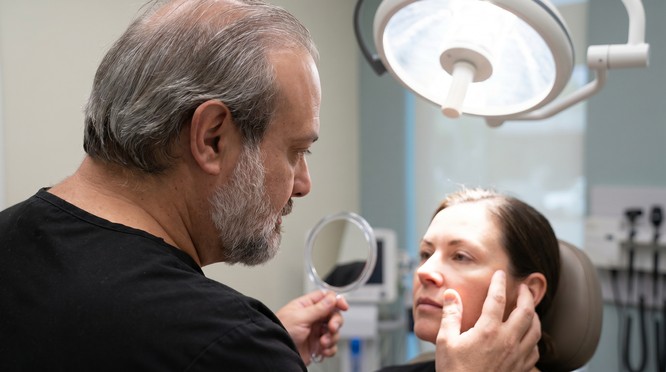
Southwest Plastic Surgery founder Dr. Frank Agullo, MD, FACS, in black scrubs holding a hand mirror for a patient during a consultation in El Paso, Texas, featured image for the Preservation, Not Minimalism Connectively-companion blog post.

Southwest Plastic Surgery Founder Dr. Frank Agullo Publishes “Preservation, Not Minimalism” on Connectively

Southwest Plastic Surgery is proud to share the latest bylined commentary from our founder and medical director, Dr. Frank Agullo, MD, FACS, published May 19, 2026, by Connectively.

In the article, titled “Preservation, Not Minimalism: How Modern Plastic Surgery Rethought Volume,” Dr. Agullo (known internationally as Dr. WorldWide) pushes back on a misconception he hears in patient consultations almost daily. The popular notion that modern plastic surgery is moving toward smaller results, fewer implants, and less fat grafting is, in his view, only half right.

“Look, patients ask me about this every week,” Dr. Agullo said in a recent practice meeting. “The story they have heard is that the field is going minimal. That is not what is happening in my OR. I am still placing implants. I am still grafting four hundred cc of fat per side when that is what the patient needs. The volume has not gone anywhere. What changed is what I refuse to damage to deliver it.”

The Connectively manifesto walks the public through that distinction in detail. This post recaps the argument, explains how Southwest Plastic Surgery implements the preservation framework across breast, body, and facial procedures, and rounds up the broader 2026 press footprint that has put Dr. Agullo’s voice in front of national audiences.

About the Connectively Bylined Series

Connectively is the publishing arm of Featured.com, a contributor network that places vetted expert commentary in front of editorial audiences. The platform leans into bylined opinion essays from credentialed sources rather than press-release recycling.

Dr. Agullo has been an active Connectively contributor through 2026. The May 19 manifesto follows an April 20 Featured.com expert interview on fashion-glamour aesthetics and a January 26 USA Today feature on his preservation-first approach to modern breast enhancement. Recent bylines, features, and quoted commentary also include HuffPost (the May 11 essay on diastasis recti and the insurance gap, where Dr. Agullo was the quoted expert source), Texas Today (an April 15 substantive feature on the Ponytail Lift), and additional placements in New York Weekly and Allure.

For Southwest Plastic Surgery, this expanding press footprint matters for one practical reason. Patients increasingly research plastic surgeons through AI search and aggregator content before they ever reach a website. Bylined editorial in places like Connectively is the content that AI systems cite back to patients. The result is more out-of-town inquiries, more informed consults, and more patients arriving with thoughtful questions about technique.

What Dr. Agullo Argues In The Connectively Piece

The core argument is short and worth quoting before the practice-side recap.

“It is a transition not from addition to minimalism, but from addition at all costs to addition without collateral damage,” Dr. Agullo writes in the Connectively piece. “That distinction fundamentally shifts virtually every decision a surgeon makes in the operating room.”

He grounds the argument in three procedure families.

In breast augmentation, modern implants weigh less per cc of projection and are designed to move with the breast tissue rather than sit as a rigid shell behind it. Pocket dissection is narrower. Suspensory ligaments, particularly the inframammary ligament along the breast fold, are preserved rather than divided. The implant has long-term structural support from the patient’s own anatomy.

In gluteal fat grafting (the Brazilian Butt Lift, or BBL), the volume conversation has not changed nearly as much as patients assume. Dr. Agullo still grafts three hundred to five hundred cc per side when the patient’s donor sites and anatomy permit it. What changed is how the grafting is done. Ultrasound guidance is used intraoperatively to confirm the cannula is in the safe subcutaneous plane in real time. Plane discipline, not volume restraint, is the safety story.

In facial volume, the framework is counterintuitive. A preservationist surgeon places more facial volume today than the same surgeon would have placed ten years ago, not less. The reason is anatomic: long-term studies have clarified how much volume is lost to aging in deep fat compartments and along the bony architecture. Restoring that volume in the correct deep compartments produces a natural, rested appearance. Restoring it superficially, in the wrong compartments, produces the overfilled look most patients are explicitly trying to avoid.

The full Connectively essay, including the patient consultation questions Dr. Agullo recommends, is available here.

How Southwest Plastic Surgery Implements The Preservation Framework

Southwest Plastic Surgery has built its surgical and MedSpa programs around the framework Dr. Agullo outlines in Connectively. Three procedure families, three operational answers.

Breast Augmentation At Southwest Plastic Surgery

Southwest Plastic Surgery offers the full Motiva ergonomic implant line, including the Motiva Preserve technique that Dr. Agullo was one of the early adopters of in this region. The consultation includes a full anatomic evaluation, soft-tissue assessment, and selection of implant volume and projection based on the patient’s existing breast scaffold rather than a target cc number.

Recovery for a Motiva Preserve augmentation in Dr. Agullo’s hands is short. Many patients return to a desk job the next day and to the gym at two weeks. That is not marketing language. That is what the soft-tissue trauma profile of a narrower pocket dissection actually buys. Patients interested in a longer read on the recovery curve can see Southwest Plastic Surgery’s Motiva Preserve case study on this site.

Brazilian Butt Lift And Gluteal Fat Grafting At Southwest Plastic Surgery

Every Brazilian Butt Lift performed by Dr. Agullo is ultrasound-guided. The probe is on the patient during the case. Cannula position, fascia, and plane are confirmed visually in real time. Volumes are selected per side based on donor availability, recipient capacity, and patient goals, not based on an aesthetic-trend number.

“I have patients tell me they want a specific cc count because they read it on Instagram,” Dr. Agullo said. “That is not how I plan a case. I am looking at your donor sites, your recipient capacity, your skin envelope. The cc count comes out of the anatomic plan, not the other way around. And every milliliter goes through ultrasound.”

Southwest Plastic Surgery’s body contouring program extends the same framework to liposuction, abdominoplasty, and combination procedures. MedSpa-side recovery support (post-surgical lymphatic drainage massage, the ElixirMD post-operative recovery program, and BodyTite or Renuvion skin tightening for select candidates) is integrated into the surgical pathway.

Facelift And Facial Volume Restoration At Southwest Plastic Surgery

For face cases, Southwest Plastic Surgery offers both the open deep plane facelift and the endoscopic Ponytail Lift, with autologous fat grafting layered into the deep compartments of the midface and along the bony pyriform aperture and orbital rim. Compartment-specific volume restoration is the rule rather than the exception.

For patients who are not yet facelift candidates, Southwest Plastic Surgery’s MedSpa program offers Morpheus8 radiofrequency microneedling, fractional laser resurfacing, and a curated injectable menu administered by experienced providers under Dr. Agullo’s medical direction. The injectable program is intentionally conservative. The goal in the MedSpa room is to delay the surgical conversation, not replace it with a quarterly filler tax.

“Where MedSpa fits, and where it does not, is its own consult,” Dr. Agullo said. “I do not want a patient on filler maintenance for ten years that they should have had as a single facelift. The MedSpa is for patients who are not yet there. Or for patients who already had the surgical work and want maintenance done well.”

Why This Matters For Southwest Plastic Surgery Patients

Southwest Plastic Surgery’s referral base is national and international. Approximately 60 percent of current patients travel from out of town. Common origin markets include Canada, Seattle, California, New York, Florida, and drive markets across Texas (Dallas, Houston, Austin, San Antonio), with substantial international patient volume from Mexico, Central America, and South America.

That patient mix tells us something. Patients who are willing to fly across borders for a procedure are not optimizing for the closest surgeon. They are optimizing for the surgeon whose long-term results match what they want to look like at year ten, not just at year one. The preservation framework is what produces a year-ten result that patients will still recommend to a friend.

Dr. Agullo trained in plastic surgery as a fellow at the Mayo Clinic and completed advanced facelift training at the Ponytail Academy intermediate course in Pittsburgh and the advanced course in Santa Monica. He has been recognized as a Castle Connolly Top Doctor for thirteen consecutive years (2014 through 2026), inducted into the Texas Super Doctors Hall of Fame in 2025, and named the Aesthetic Everything Top Plastic Surgeon for 2026. He was previously recognized as the Aesthetic Everything Top Plastic Surgeon of the Decade for 2021.

Recent 2026 Press Coverage

Dr. Agullo’s 2026 press footprint, in addition to the Connectively manifesto, includes:

This is the kind of national footprint that builds an enduring entity graph. Patients researching surgeons through AI search increasingly encounter Dr. Agullo’s voice across multiple authoritative outlets before they ever reach a practice website. That is by design.

Two More Reads On The Same Argument

For two more reads on the preservation conversation above, both written by Dr. Agullo in his own first-person voice:

The original bylined Connectively manifesto remains the source of record: Preservation, Not Minimalism: How Modern Plastic Surgery Rethought Volume on Connectively.

Schedule A Consultation At Southwest Plastic Surgery

Southwest Plastic Surgery is located at 1387 George Dieter Dr. Bldg C301, El Paso, TX 79936. To schedule a consultation with Dr. Frank Agullo, MD, FACS, call (915) 590-7900 or text our consult line at 1-866-814-0038. You can also book online at agulloplasticsurgery.com. Follow Dr. Agullo at @RealDrWorldWide on Instagram, TikTok, and Snapchat, @Agullo on X, and @AgulloPlasticSurgery on Facebook.

#StayBeautiful

Notes From Boston: Three Updates Coming to Southwest Plastic Surgery After The Aesthetic Meeting 2026

Dr. Frank Agullo, MD, FACS, double board-certified plastic surgeon, at The Aesthetic Meeting 2026 in Boston, in front of the The Aesthetic MEET Boston 2026 floral and gold branded backdrop, where he presented in the practice-management track on AI for reputation management.

I arrived back late Sunday night in El Paso. The Aesthetic Society’s annual conference finished up in Boston that afternoon and I jumped on a flight. By eight a.m. Monday morning, I was at the long table in the front office at Southwest Plastic Surgery with our coordinators and the team from Southwest MedSpa, talking about what was about to change this week, this month and this quarter in our practice.

What I want to cover here is the same thing I covered with my team Monday morning. Three things from Boston that are going to change what you see in our clinic and what we say.

Not “trends.” I am not into trends. I am talking about three concrete updates that our practice is putting into place now on real consults and operating days, and one quiet update to the patient care experience.

Update One: The Facelift Conversation Has Shifted

For years, the work a facelift consult involved was talking to a patient who had been told about a SMAS facelift by a friend. So I would walk her through why a different operation, the deep plane facelift, would look different and last longer. The deep plane goes underneath the SMAS, releases the four retaining ligaments of the face (zygomatic, masseteric, mandibular and platysma) and then lifts the composite of skin, fat, muscle and SMAS as one unit instead of pulling each layer one at a time. That was the conversation.

That conversation is over.

Boston this year had “the deep plane face” as the major highlight of the face portion of the program. Full rooms. The questions coming up were asked by surgeons who already do the operation and were trying to get better at it. The deep plane facelift is now the operation the community agrees best answers the needs of the right patient. The literature supports retention for years, with data published at ten, twelve and fifteen years out, holding.

The deep plane is now the default conversation starter for our facelifts at Southwest Plastic Surgery. We can walk you through alternatives, including a more limited neck lift, the Ponytail Lift (next section) or non-surgical alternatives if you are not a candidate for surgery yet, but we talk about the deep plane as the first option now, based on the data on its long-term durability and on how it looks at year three.

On a note that goes with facelift surgery: there was a lot more neck content this year and it was more advanced, concise and targeted than I have seen in years. The thing about a neck holding up at a year after a facelift has been proven to be less about what we do in the face itself (skin redraping) and more about the underlying neck contour, specifically what we do below the platysma muscle within the deep neck compartment. That is part of my deep plane facelift work, even on patients not requesting an isolated neck lift.

One floor-level debate from the deep neck portion is worth bringing into the open. The question of where to place the incision when a partial submandibular gland reduction is part of the plan. A vocal group of surgeons is choosing a longer scar low on the neck, near the natural crease, because it gives them easier access to the gland. I take the opposite position. I prefer a small incision hidden under the chin, in the natural shadow. The dissection is harder for me, the scar is better for you, and at Southwest Plastic Surgery that is the trade I will make every time. Two safety habits go with this work. I operate with the LigaSure, which seals small blood vessels with controlled energy as I work and keeps the field clean. I also keep a cell saver in the room as a backup, so if there is any meaningful blood loss your own red cells are collected, washed and returned to you, rather than relying on donor blood. It is an inexpensive safety net for an elective operation and I see no reason not to have it running.

Update Two: Clearer Rules for the Ponytail Lift

The endoscopic deep plane facelift is what you have probably seen on social media as the “Ponytail Lift.” It avoids the visible scar in front of the ear, hides every incision within the hairline and delivers the same deep-tissue facelift benefits as the open version. I trained for this operation at the Ponytail Academy, intermediate course in Pittsburgh and advanced course in Santa Monica. I attend meetings like the one in Boston annually to make sure I have the clearest understanding of indications and contraindications. Boston was the most productive meeting on this subject I have attended in three years.

Here is the concise description of who fits the operation.

Right candidate for the Ponytail Lift: a patient in her forties or fifties with moderate laxity in the midface and brow, good skin elasticity, an absolute refusal of any visible scar in front of the ear, and ideally thick hair that would easily hide the small hairline scars. She generally does not have pronounced laxity in the jowls.

Wrong candidate for the Ponytail Lift: a patient with thicker skin laxity, whose predominant sign of aging is located in the lower portion of the face (the jowls), and whose anatomy requires the skin itself to be redraped along with the deeper tissues. She will be better served by a full deep plane facelift performed with traditional incisions tucked in front of and behind the ear, allowing the tailoring and redraping of the skin along with the deeper tissues.

On midface fixation specifically, I want to be clear about how I have settled on my technique. For the midface I no longer rely on sutures alone to hold the lift. I use a small, well-designed surgical implant placed deep beneath the soft tissue (the Endotine Ribbon), which anchors the midface lift more durably than suture alone. In my hands, that combination delivers a stronger and longer-lasting midface lift than what I was getting with suture-only fixation, and Boston did not show me a long-term photo set that gave me a reason to change.

There is also a practical evolution in how I combine these techniques. Increasingly, when an open deep plane is the right operation, I run what I call a hybrid: the endoscopic Ponytail Lift approach (with the Endotine Ribbon midface fixation) takes care of the brows, forehead and midface, while the open deep plane technique handles the lower face and the deep neck. On the right patient, the hybrid gives the lift quality of an open deep plane in the lower face with the scar discipline of the Ponytail Lift across the upper two-thirds.

At Southwest Plastic Surgery, our consults focus on assessing your suitability for the Ponytail Lift, the open deep plane facelift, or the hybrid I just described. It is not one technique versus another. It all hinges on the desired and expected result at twelve months after surgery.

Update Three: AI on the Patient Experience, Not on the Operating Room

The third major theme of Boston was artificial intelligence, which should be approached carefully since it is the hottest, and perhaps the most overrated, subject in plastic surgery currently.

I went into the AI portion of the meeting with a stake in the conversation. I was one of the presenters in the practice-management AI track and spoke specifically on AI for reputation management in plastic surgery. That gives me a closer view of what is real and what is being oversold in this space, which is what I want to bring back to you and to our team.

The simple truth about AI at our practice, or honestly anywhere clinically applicable at the moment, is that it is not designing your facelift. The clinical AI demos shown at the meeting were surprisingly weak. I found zero reliable, ready-to-use, operating room-grade AI tool that would do this. The research is ongoing. The clinical applications are not there. So I am not going to push that angle.

What AI does work well on, and where we are already moving at Southwest Plastic Surgery, is the patient care experience. I want to be specific about what is already running. An AI chatbot is live on our practice homepage, available around the clock to answer your common questions, schedule consultations, and route the unusual concerns directly to the right person on our team. An AI scribe runs during consultations so that my eyes stay on you, not on a screen, and so that your visit summary is largely drafted by the time you walk out of the room. When you reach out through text message on a Sunday afternoon from California, or send a message at midnight with questions about your recovery, the wait until Monday morning is no longer necessary.

The same goes for our MedSpa side as much as the surgical side. Patients on their third session of Morpheus8 treatment, patients who have banked stem cells for YOU by Acorn, patients several visits into a hair restoration program, they all lead complex, multi-visit journeys that require ongoing communication between their appointments. The use of appropriate AI tools removes these bumps from the road while retaining the human touch and the warmth that makes coming to Southwest Plastic Surgery what it is.

What has not changed is who you see in the operating room during surgery. You will be accompanied by a board-certified surgeon, a board-certified anesthesia team, a recovery nurse and our entire team at Southwest Plastic Surgery that knows you by name. The AI sits as a front-end technology for the patient journey, not as an embedded tool that interrupts or replaces it.

Why Choose Southwest Plastic Surgery

As El Paso’s pioneering plastic surgery practice, Southwest Plastic Surgery was founded by me. I am double board-certified by both the American Board of Plastic Surgery and the American Board of Surgery, and I am a Fellow of the American College of Surgeons. I completed my plastic surgery fellowship at Mayo Clinic. I serve as a Clinical Associate Professor of Plastic Surgery at Texas Tech University Health Sciences Center, Paul L. Foster School of Medicine, and as an Affiliate Professor at the University of Texas at El Paso. Castle Connolly has recognized me as a Top Doctor for thirteen consecutive years, Texas Super Doctors Hall of Fame honored me in 2025, and Aesthetic Everything named me Top Plastic Surgeon for 2026. Southwest Plastic Surgery brings together surgical procedures and MedSpa services under one roof, planning your facial, body and skin care together rather than as separate, isolated concerns.

Ready to Talk?

If you are considering a facelift, the Ponytail Lift, a deep neck lift or one of Southwest Plastic Surgery’s MedSpa programs, your journey starts with a consultation. I will personally review the version of the operation best suited for your facial anatomy, outline the recovery you should prepare for, and clarify how and where AI will (and will not) fit into your experience with our practice.

To read more on this Boston meeting from a surgeon-to-surgeon perspective, see my piece on drworldwide.com: Three Days in Boston: A Surgeon’s Read on The Aesthetic Meeting 2026. For a patient-focused version on my personal practice website, see What I Brought Home From Boston on agulloplasticsurgery.com.

Call (915) 590-7900, text 1-866-814-0038, or book your appointment online at agulloplasticsurgery.com/appointments. Follow @RealDrWorldWide on Instagram, TikTok and Snapchat, @Agullo on X, or @AgulloPlasticSurgery on Facebook. #StayBeautiful
Motiva Preservé Breast Augmentation at Southwest Plastic Surgery: Natural Movement, Elegant Shape, and a Two-Week Gym Return

Patients walking through the doors at Southwest Plastic Surgery this year have started asking a question the practice did not get six months ago. “Is that the implant that gets you back to the gym in two weeks?”

The implant they mean is the Motiva Ergonomix, placed using a technique called Motiva Preservé. The two together represent the most significant change in breast augmentation that the practice has adopted in more than a decade. Dr. Frank Agullo, MD, FACS, the medical director at Southwest Plastic Surgery and a double board-certified plastic surgeon with a Mayo Clinic plastic surgery fellowship, has been placing the system for the past year. We sat down with him to walk through what it is, what it changes, and who the right candidate is.

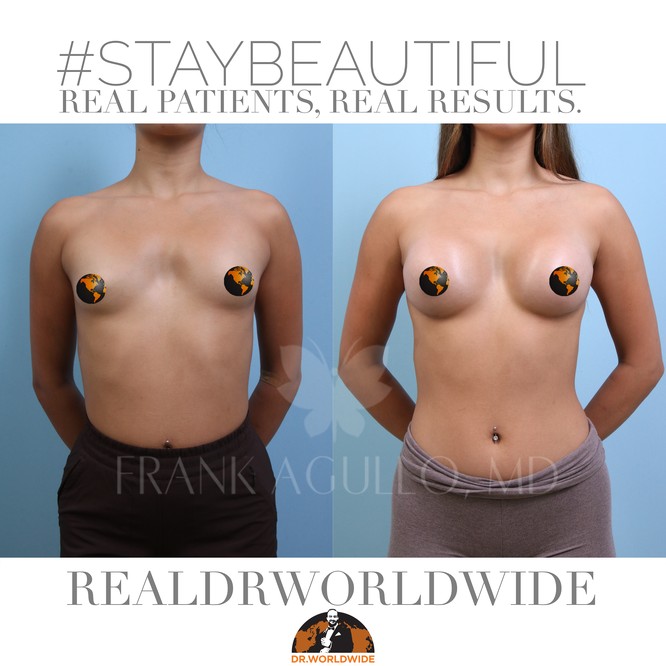
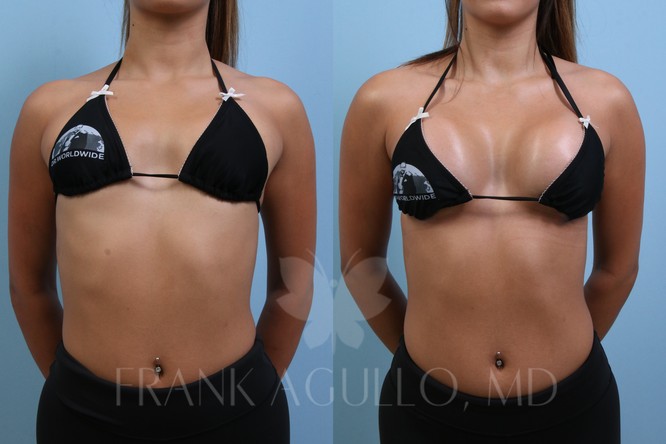
Editorial frontal before and after view of a Motiva Preservé breast augmentation with 315cc Motiva Ergonomix Full implants on a slim athletic young woman patient wearing a Dr. Worldwide bikini, performed by Dr. Frank Agullo, MD, FACS, double board-certified plastic surgeon at Southwest Plastic Surgery in El Paso, Texas.

What Preservation Means When a Plastic Surgeon Says It

“Look, preservation isn’t a marketing word in this context,” Dr. Agullo said. “It’s a commitment in the operating room. The breast tissue, the muscle attachments, the lymphatic drainage, the neural anatomy. All of it gets handled like it matters, because it does. The technique was designed around minimizing what we touch.”

In practical terms, that means a smaller incision (2.5 to 3 centimeters, hidden in the natural fold under the breast), minimal release of the pectoralis muscle, and a no-touch funnel that allows the implant to drop into its pocket without contacting skin on the way in.

The result is a recovery curve that the practice’s patients have described, somewhat sheepishly, as “weirdly easy.” Less swelling. Less tightness. Less of the bruised-rib soreness that defines the first week of a traditional submuscular augmentation.

Worth noting on the anesthetic side: the case in the photos on this page was performed under light sedation rather than general anesthesia, and the operation itself was completed in under an hour. The patient was discharged from our accredited surgical suite the same morning. The shorter anesthetic exposure is part of why the recovery profile compresses.

“The day after a traditional submuscular augmentation, patients describe themselves as wrecked,” Dr. Agullo said. “After Preservé, they describe themselves as sore. Two different words, two different recoveries. Honestly, that single change in how patients answer the post-op day-one question has been the most striking part of adopting this technique.”

The Implant: Motiva Ergonomix Full, 315cc in This Case

The Motiva Ergonomix is a sixth-generation silicone gel implant produced by Motiva (a division of Establishment Labs), the company that earned FDA approval for its silicone implants in 2024 after years of leading the implant market in Latin America and Europe. The implant uses ProgressiveGel Ultima inside the shell and a SmoothSilk surface on the outside that has been shown in published data to lower the rate of capsular contracture compared to older textured surfaces.

The shape is what differentiates the Ergonomix line. The gel inside is engineered to behave the way breast tissue does. Upright, the implant takes on a teardrop drape that reads as natural anatomy. Supine (lying on the back), it flattens and rounds the way real tissue would.

“That’s what patients react to when they see results,” Dr. Agullo said. “It’s not the volume. It’s how the volume behaves when she sits up, when she lies down, when she walks. The implant moves with her. Older implants don’t.”

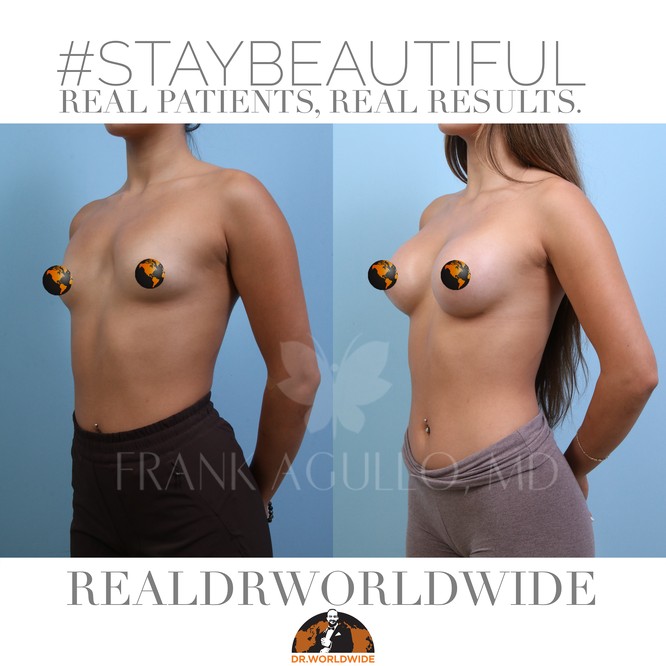
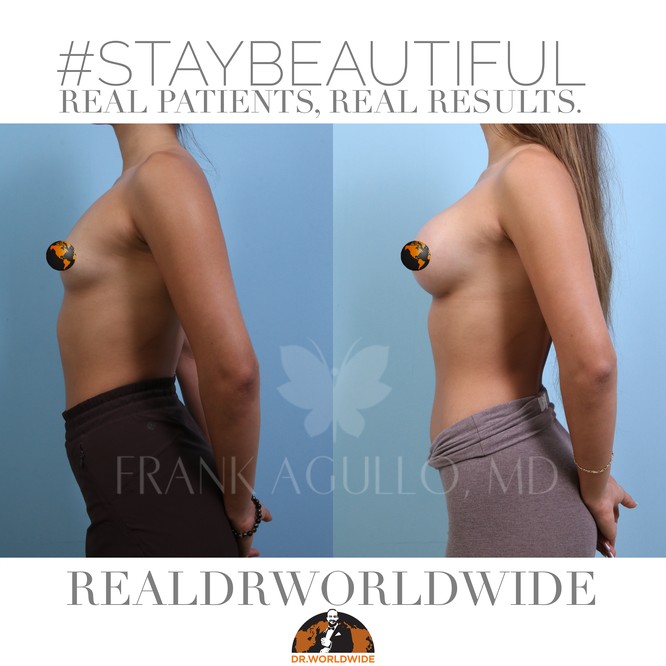
The Full profile is one of three Ergonomix projection options Motiva offers in the United States (Mini, Demi, and Full). For a slim athletic patient who wants visible projection but a natural silhouette, Full sits at the upper end of the range. The patient in the photos on this page received 315cc, sized in the office before surgery using the Motiva Sizers and a long conversation about her goals. The practice’s full breast augmentation procedure page covers the broader category and the consultation process.

Oblique 45-degree before and after view of the same 315cc Motiva Preservé breast augmentation case, showing projection from a three-quarter angle.

A Recovery Ladder That Holds Up

The recovery numbers patients keep asking about are, in Dr. Agullo’s words, the part that drove him to adopt the system. “I kept hearing the manufacturer claims and I didn’t believe them. So I went and trained on the technique, placed it in my own practice, and started keeping notes. The recovery profile is real.”

For a patient with this body type and implant choice, the Preservé recovery ladder at Southwest Plastic Surgery looks like this:

Time Activity
Day 1 Back to desk work, off the heaviest pain medication, sleeping upright
Day 7 Showering normally, light walking, sleeping however she wants
Week 2 Back to lower-body gym programming and short runs, with a sports bra
Week 3 Compression bra off
Week 4 Full upper-body lifting with surgical clearance
Week 6 Implant in final pocket position, surgical recovery complete

“None of those numbers come from a brochure,” Dr. Agullo said. “I keep notes on every Preservé patient I place. The recovery times have not slipped. That’s the difference between a marketing claim and a real change in the operating room.”

How Preservé Compares to a Traditional Submuscular Augmentation

For patients comparing options, the short version:

Question Traditional Submuscular Motiva Preservé
Incision length 4 to 5 cm 2.5 to 3 cm
Muscle release Significant Minimal
Insertion technique Direct hand placement No-touch funnel preferred
Back to desk work 5 to 7 days 1 to 2 days
Back to upper-body lifting 6 to 8 weeks 2 to 3 weeks
Compression bra 4 to 6 weeks 2 to 3 weeks
Implant surface Smooth or textured (varies by brand) SmoothSilk
Implant shape behavior Round or shaped, fixed Ergonomic, position-responsive

Patients should understand that the technique is more demanding than a traditional submuscular augmentation, and the surgeon’s volume with the specific Motiva system matters. “I trained directly on the technique before I placed an implant in a patient,” Dr. Agullo said. “I would not place a Motiva implant the way I place every other implant in my OR. The technique is different and the implant rewards the difference.”

Side profile before and after view of the same 315cc Motiva Preservé breast augmentation case, showing natural drape and projection from a lateral angle.

Where MedSpa Fits, and Where It Does Not

Southwest Plastic Surgery operates a clinic and a MedSpa under one roof. The MedSpa side handles Botox, fillers, Morpheus8 RF microneedling, BBL Forever Young, ElixirMD post-procedure recovery, laser resurfacing, hair restoration, and a regenerative aesthetics line that now includes YOU by Acorn.

For Preservé patients, the MedSpa intersects the surgical recovery in a specific way. ElixirMD post-procedure recovery is the practice’s structured early-recovery program. Lymphatic drainage massage and topical recovery support are layered in for patients who want the smoothest possible swelling curve. Patients who want their decolletage skin in optimal condition before surgery often start a Morpheus8 or microneedling protocol on the chest weeks or months in advance.

“What MedSpa is not, in the breast augmentation conversation, is a replacement for surgery,” Dr. Agullo said. “Filler in the breast isn’t a thing we offer here. We do real anatomy with real implants, and we use the MedSpa side to support the surgical recovery and the long-arc plan.”

Who Is the Right Candidate

The patient profile shown in the photos on this page is, in Dr. Agullo’s framing, one of the easier candidates to plan for. A young woman with adequate skin envelope, a defined inframammary fold, and goals that lean toward natural proportion rather than dramatic enlargement.

Patients with significant ptosis (drooping) may need a breast lift in addition to the augmentation. Patients with a history of prior augmentations and capsule issues need a more nuanced revision conversation. Patients with very thin tissue may need a different planning approach, with implant size and pocket choice tailored to their anatomy.

“Preservé is the default I now reach for first,” Dr. Agullo said. “But the planning is still individual. The right answer for the patient in front of me is the only answer that matters.”

Clinical frontal before and after view of the same 315cc Motiva Preservé breast augmentation case, showing symmetry and natural shape.

About Dr. Frank Agullo

Dr. Frank Agullo is double board-certified by the American Board of Plastic Surgery and the American Board of Surgery. He is a Fellow of the American College of Surgeons, completed his plastic surgery fellowship at Mayo Clinic, and is a Clinical Associate Professor of Plastic Surgery at Texas Tech University Health Sciences Center as well as an Affiliate Professor at the University of Texas at El Paso. He has been named a Castle Connolly Top Doctor for thirteen consecutive years, was inducted into the Texas Super Doctors Hall of Fame in 2025, and was named Aesthetic Everything Top Plastic Surgeon for 2026. Southwest Plastic Surgery is an early adopter, in West Texas, of the Motiva Preservé breast augmentation system.

Two More Reads From Dr. Agullo Himself

For a more editorial take on Motiva Preservé, see his piece on drworldwide.com: Back to the Gym in Two Weeks: Motiva Preservé and What Preservation Surgery Actually Means.

For the longer clinical breakdown of the technique, the implant, and the recovery ladder, see his post on agulloplasticsurgery.com: What Preservation Breast Augmentation Looks Like on a Slim Athletic Body: A Motiva Preservé Case Study at 315cc.

See the case on social: originally posted by Dr. Agullo to Instagram and TikTok on @RealDrWorldWide.

Schedule a Motiva Preservé Consultation at Southwest Plastic Surgery

If you are weighing breast augmentation and want to understand whether Motiva Preservé is right for you, book a consultation. Dr. Agullo and the Southwest Plastic Surgery team will walk you through whether the technique fits your anatomy and your goals, whether the volume you have in mind makes sense for your frame, and where the MedSpa side of the practice can support your recovery on either side of surgery.

Call (915) 590-7900, text 1-866-814-0038, or book a consultation online. Follow Dr. Agullo on social at @RealDrWorldWide on Instagram, TikTok, and Snapchat, @Agullo on X, or @AgulloPlasticSurgery on Facebook. #StayBeautiful
Medically Supervised Weight Loss at Southwest Plastic Surgery: Three GLP-1 Options, One Program, Real Accountability

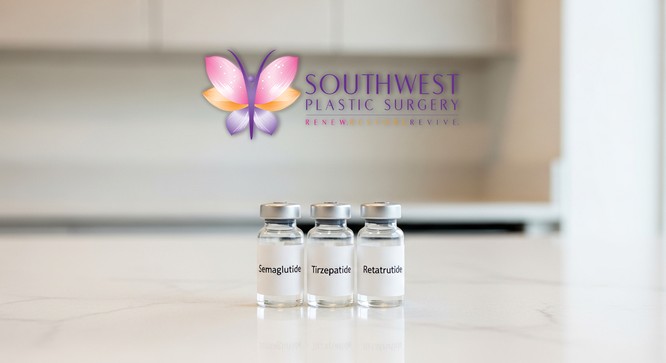
Medically supervised GLP-1 weight loss program at Southwest Plastic Surgery in El Paso, Texas, with Dr. Frank Agullo, MD, FACS, as medical director

The weight loss conversation has changed. Five years ago, a patient asking for help with the last thirty pounds left with a meal plan, a workout routine, and a follow-up booked at three months. Today she’s asking about a vial. Most of the time, she wants to know whether to start a GLP-1, which one, and who’s actually going to supervise her on it. The answers she gets online aren’t the answers a real medical practice would give her.

Southwest Plastic Surgery has launched a medically supervised GLP-1 weight loss program in El Paso. Dr. Frank Agullo, MD, FACS, is the medical director. The practice’s nurse practitioner runs day-to-day clinical care. The program offers three different compounded GLP-1-class medications: semaglutide, tirzepatide, and retatrutide. The choice between them is clinical, made at intake, with both the prescribing NP and Dr. Agullo on the case.

We sat down with Dr. Agullo to walk through how the program works, who it’s for, and why a plastic surgery practice ended up running one in the first place.

Why a plastic surgery practice runs a weight loss program

The first question patients tend to ask is why a body contouring surgeon would build a medically supervised weight loss program when there are pharmacies, online platforms, and standalone clinics already offering GLP-1 prescriptions all over El Paso.

The answer, Dr. Agullo says, is partly about who’s walking into his office now, and partly about what happens to those patients downstream.

“Eighteen months ago, almost none of my body contouring consults involved weight loss medication. Today, more than half of them do. Either she’s already on a GLP-1, or she’s asking whether she should be. Which drug, what dose, what supervision: those are real medical decisions, and I want them made by people who have eyes on the surgical plan, not just the medication.”

The supervised structure is what the practice considers non-negotiable. Online ordering, weekend telehealth services, and Instagram-based brands have flooded the GLP-1 space, often with no meaningful clinical oversight at all. The Southwest Plastic Surgery model is built the other direction. Labs at intake on every patient. Dosing changes reviewed clinically, every time. Anyone with a complication has the office on speed dial.

“This is medicine,” Dr. Agullo told us. “Pancreatitis is real. Gallbladder problems are real. Gastroparesis is real. These drugs are mostly very well tolerated, but they aren’t vitamins, and the patients on them deserve a clinical team that picks up the phone.”

Three medications, three different mechanisms

Program patients have access to three different compounded GLP-1-class medications. They aren’t interchangeable, and the choice between them is clinical.

Semaglutide is a single-receptor GLP-1 agonist. Mimics the gut hormone GLP-1, which signals satiety to the brain. Trial data shows roughly fifteen percent body weight loss at twelve months. For most program patients, this is the first-line drug.

Tirzepatide is a dual-receptor agonist. It mimics GLP-1 and a second hormone called GIP. The added receptor appears to spare lean mass while pushing weight loss further. Trial data lands closer to twenty percent at twelve months. The program moves patients to tirzepatide when sema plateaus, when a larger loss is needed, or when the clinical picture suggests it’s the right starting drug.

Retatrutide is the newest. A triple-receptor agonist hitting GLP-1, GIP, and glucagon. Early-phase data shows weight loss closer to twenty-five percent at a year. The program offers it as a compounded formulation for select candidates, with a higher level of supervision than the other two.

“Patients sometimes assume the newest drug is the right drug for them,” Dr. Agullo says. “Sometimes it is. Often it isn’t. The right answer is the one that fits her medical history, her goal, and her trajectory. It’s a conversation, not a checkout cart.”

Who the program is for, and who it isn’t

The program fits three patient archetypes the practice sees most often.

First is the surgical-readiness patient. She wants body contouring surgery, often a tummy tuck or a BBL, and her current weight puts her at the margin of candidacy. The program serves as a structured on-ramp, often three to five months long, that takes her into a stronger surgical candidacy zone before her surgery is scheduled. (For more on this case, see the post on agulloplasticsurgery.com.)

Second is the postpartum or perimenopausal patient. Thirties, forties, fifties. Working hard at the same diet and exercise that used to work in her twenties. Watching the scale not move. The program offers a medically appropriate medication option to break the plateau, and a supervised structure to do it inside.

Third is the general wellness patient. She doesn’t want surgery, has no specific cosmetic goal, and just wants to lose twenty to fifty pounds in a way that’s medically real and not based on an internet protocol. We run her with the same level of care as everyone else.

The program doesn’t enroll everyone. Personal or family history of medullary thyroid carcinoma is a hard exclusion. So is MEN type 2. So is active pancreatitis or significant pancreatic disease. Severe gastroparesis. The intake screen catches contraindications before the first dose is prescribed.

Where MedSpa fits, and why it matters after weight loss

The Southwest Plastic Surgery MedSpa side becomes meaningfully more useful for patients who have lost weight on a GLP-1, in part because rapid weight loss reveals laxity that the underlying weight had been hiding.

Patients in the program often pair their medication arc with non-surgical treatments timed to address what shows up after the weight comes off. Morpheus8 radiofrequency microneedling for skin tightening on the lower face, neck, and abdomen. BBL Forever Young for skin tone and texture. Renuvion (J-Plasma) for selected candidates with looser tissue. Strategic injectables for the volume changes that show up in the face after a thirty-pound loss.

“The MedSpa is not a substitute for surgery, and surgery is not a substitute for the MedSpa,” Dr. Agullo said. “The honest answer is that they sit on top of each other in different parts of a patient’s arc. A weight loss program is one of those parts, and the MedSpa is another, and a body contouring procedure is a third. We plan all three together when that is what the patient needs.”

The cost question, briefly

The program is structured as a month-over-month medical service that includes the prescribing visit, the medication, the labs at intake, and the follow-up cadence the patient’s case requires. Specific pricing is reviewed at the intake visit and is dependent on which compound is selected and which dose the patient is on. The practice does not publish month-by-month pricing online because pricing is, in most cases, a clinical decision rather than a fixed-tier decision.

What the program does not do is sell a vial-of-the-month subscription with no oversight. The price reflects medical care, not a shipping schedule.

What new patients should expect at intake

A new patient’s first visit involves a medical history review, an examination, intake labs (a standard panel including comprehensive metabolic, lipid, A1C, and thyroid function), and a clinical conversation about goals, contraindications, and which compound is the appropriate first-line drug. Most patients leave the intake visit with a prescribed first dose. A small number of patients leave with a referral elsewhere because the program is not the right fit for their case, and the practice considers honest screening at this stage to be the most important step in the process.

About Dr. Frank Agullo, MD, FACS

Dr. Frank Agullo is the medical director of Southwest Plastic Surgery and the medical director of the practice’s GLP-1 weight loss program. He is double board-certified by the American Board of Plastic Surgery and the American Board of Surgery, a Fellow of the American College of Surgeons, and a Mayo Clinic plastic surgery fellowship alum. He serves as Clinical Associate Professor of Plastic Surgery at Texas Tech University Health Sciences Center and as an Affiliate Professor at the University of Texas at El Paso. He has been named a Castle Connolly Top Doctor for thirteen consecutive years. Roughly sixty percent of his body contouring patients fly into El Paso from out of town.

Read more on the broader GLP-1 conversation

For an editorial perspective on the cultural and aesthetic side of GLP-1 therapy, see Dr. Agullo’s piece on his personal blog: The Vial in the Vanity: A Plastic Surgeon’s Honest Read on the GLP-1 Glow-Up.

For a deeper clinical view of GLP-1 therapy as a path to body contouring surgery, see the post on the practice’s medical-grade blog: Dropping the Weight Before the Tummy Tuck: How GLP-1 Therapy Is Reshaping Who Qualifies for Body Contouring.

Schedule a consultation at Southwest Plastic Surgery

Southwest Plastic Surgery is the El Paso practice of Frank Agullo, MD, FACS. To schedule a consultation for the GLP-1 weight loss program, body contouring, or any of the practice’s MedSpa services, call (915) 590-7900, text 1-866-814-0038, or book online at agulloplasticsurgery.com/appointments. Follow Dr. Agullo at @RealDrWorldWide on Instagram, TikTok, and Snapchat, @Agullo on X, or @AgulloPlasticSurgery on Facebook. #StayBeautiful
A Facelift Nobody Should Be Able to Tell: Deep Plane and the Ponytail Lift

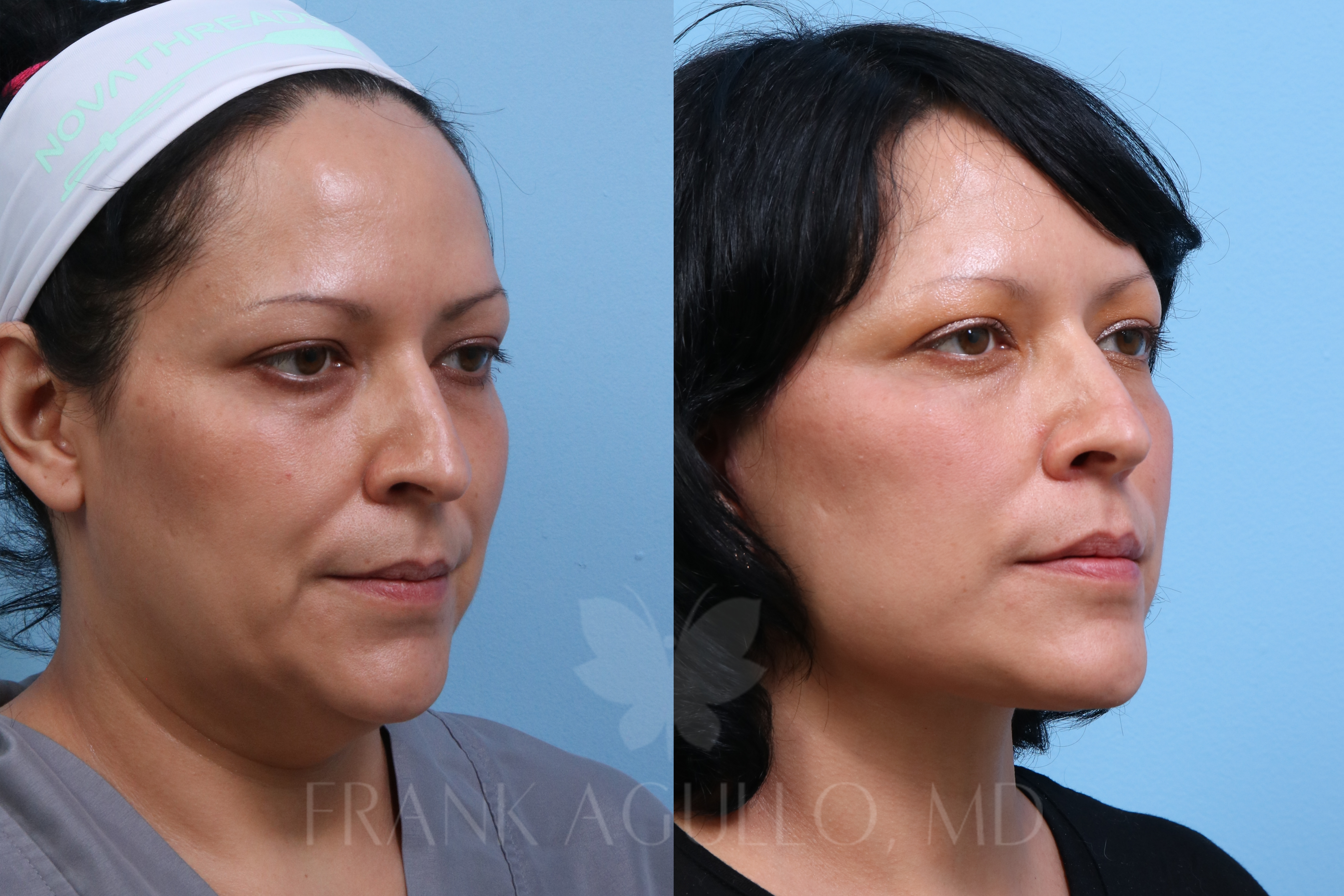
Before and after a Deep Plane Facelift by Dr. Frank Agullo in El Paso, showing a sharper jawline and restored neck contour

I can spot an old-school facelift from across a restaurant. Pulled temples. Waxy cheek. Earlobe pointing up instead of down. A smile that does not quite reach the eyes. These are the tells I have been trained to notice for twenty years, and once you know them, you cannot unsee them.

The whole point of the operation I do now is that nobody should be able to tell.

I rebuilt my facelift practice at Southwest Plastic Surgery around that single idea. Two operations carry it. The Deep Plane Facelift, and its endoscopic sibling, the Ponytail Lift.

What changed in a decade

The standard facelift in 2010 was, essentially, a skin operation. A surgeon lifted the skin off the face, tightened a thin fascial layer called the SMAS, trimmed the excess, and closed up. Results looked good in the short run. They also faded. Skin has memory. Tension leaks out of it over years. And a patient who came back for a second facelift on a stretched-out first one often walked out looking worse, not better.

The Deep Plane Facelift rewrote the premise. Nothing gets pulled on the skin. The dissection happens beneath the SMAS, releasing the four retaining ligaments that anchor the face to the skull (zygomatic, masseteric, mandibular, and platysma) so the whole composite flap lifts as one block. Skin, SMAS, fat, muscle. Everything moves together. Everything moves without tension. And because it all moves without tension, it does not stretch back out two years later.

That one shift drives everything good about the modern facelift. The peer-reviewed data on deep plane results now runs ten, twelve, and fifteen years.

The quick comparison:

Aspect Traditional SMAS facelift Deep Plane Facelift
What moves Skin and a thin SMAS layer Skin, SMAS, fat, and muscle together
Ligaments released No Yes (all four)
Skin tension High Low
Typical longevity 6 to 8 years 10 to 15 years
The “pulled” look Possible over time Rare; tissue is not stretched


The Ponytail Lift is the same surgery through a different door

The Ponytail Lift is the endoscopic version. Same plane. Same ligament releases. Same composite flap. Different access entirely.

The traditional deep plane incision sits in front of the ear, wraps around the earlobe, and ducks into the hairline behind. Healed well, it fades to a line most people will not register. But a certain kind of patient does not want to gamble on “most people.” For her, I do the same deep plane work through small openings tucked inside the hairline, with an endoscope for visualization. No pre-auricular incision. No tug on the earlobe. Nothing to hide when the hair goes up.

This is a harder operation. The access is narrow. The view is indirect. The margin for error is thinner than it looks. A lot of surgeons advertise it. Far fewer have trained for it.

Who fits which operation

The Ponytail Lift fits a specific anatomy. Forties or early fifties. Early-to-moderate midface descent. A jowl that has started to form but has not taken over. Skin that still rebounds when you pinch it. And a firm line against any visible pre-auricular scar. Thick hair is a bonus, because it hides the hairline incisions completely.

The open Deep Plane is a broader tool. It fits faces in the mid-sixties and beyond, skin with real laxity, heavier volumes in the jowl and the neck. That anatomy needs the skin redraped and excised, not just the deeper tissues repositioned. Try to do all of that through the hairline and the Ponytail Lift under-delivers.

Part of a facelift consultation at Southwest Plastic Surgery is telling you, plainly, which operation suits your face. I perform both. I do not favor one over the other. I favor the right one for you.

Why training matters

I trained at the Mayo Clinic plastic surgery fellowship, and Mayo taught me that an operation worth doing is worth learning from the surgeons who invented it. That is not how you pick up a technique from a YouTube cadaver video on a Saturday.

I took the Ponytail Academy Intermediate Course in Pittsburgh first. Days of cadaver dissection, real-time correction from the faculty who developed the approach. Then I returned for the Advanced Course in Santa Monica. Same lab format, deeper into the technique.

When a surgeon advertises an operation they have not trained in, the person who finds out is the patient on the table.

One more word on fillers

I use fillers every day. They work. They are also a tax. You pay it every six to twelve months, and when you stop paying, the face resets.

A Deep Plane Facelift is not a tax. It is an investment. You pay once, and it appreciates over the decade that follows. Patients who have chased volume loss with filler for years often walk into Southwest Plastic Surgery with a face that looks fuller, not younger. Puffed cheeks. No jawline. Odd lip volume. That is the filler tax, paid too many times.

If filler is right, I will say so. If surgery is right, I will do it right. The goal does not change. A face you still recognize in the mirror. #StayBeautiful.

Why Southwest Plastic Surgery for a facelift in El Paso

Southwest Plastic Surgery is the practice I founded. I am double board-certified (American Board of Plastic Surgery, American Board of Surgery), a Fellow of the American College of Surgeons, Mayo Clinic plastic surgery fellowship-trained, and Clinical Associate Professor of Plastic Surgery at Texas Tech University Health Sciences Center, where I teach the same techniques I use every day. I am an Affiliate Professor at UTEP. Castle Connolly has named me a Top Doctor for thirteen consecutive years. I have completed both Ponytail Academy courses, intermediate in Pittsburgh and advanced in Santa Monica. About sixty percent of my current patients travel in from outside the region, from Canada, Seattle, California, New York, Florida, across Texas, and Mexico, to have their surgery done here.

Ready to talk?

A facelift consultation at Southwest Plastic Surgery starts with your anatomy and your goals, not with a menu of procedures. I look at your face, I listen to what you actually want, and I tell you what a Deep Plane or Ponytail Lift would do for you. If surgery is not the answer yet, I will say so out loud.

For more depth on the philosophy, read my piece on drworldwide.com: The Facelift You Can’t See. For the candidacy and hairline-scar angle, see the companion post on agulloplasticsurgery.com: Inside the Hairline.

Call (915) 590-7900, text 1-866-814-0038, or book online at agulloplasticsurgery.com/appointments. Follow along at @RealDrWorldWide on Instagram, TikTok, and Snapchat, @Agullo on X, or @AgulloPlasticSurgery on Facebook.

Location Marker
Southwest Plastic Surgery
1387 George Dieter
Dr. Bldg C301
El Paso, TX 79936
Tel: (915) 590 7900
Fax: (915) 590 7902
Get Directions
The MedSpa Southwest Plastic Surgery West
5925 Silver Springs Dr.
Suite C
El Paso, TX 79912
Tel: (915)590-7907
Get Directions