En Español

« Back to Blog

The Collagen Aisle, Ranked: What Our Patients Ask Us Every Week

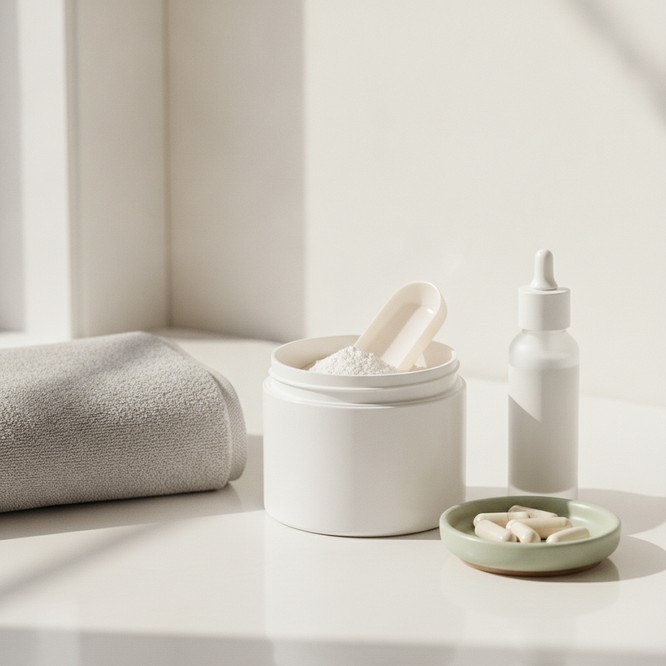
Collagen powder, capsules, gummies, and a serum bottle arranged on a bright counter, illustrating collagen supplement guidance from Southwest Plastic Surgery in El Paso.

The clinic sees more collagen ingestibles arrive than the average pharmacy. First off, a giant tub of unflavored collagen powder a patient has been using since January, who insists he takes it after hearing a lady down the street rave about it. Then, an electric-green gummy pouch discovered inside the purse of another patient at the point of signing out.

So. Will it achieve anything useful, you think?

Flow Space interviewed Dr. Frank Agullo on precisely that subject, powders versus serums versus capsules versus gummies. Here is the full answer he gave.

Why Patients Start Looking in the First Place

Actually, the ads are not pushing the supplement. It is people standing in front of their mirror and watching it go bad there.

Below the epidermis entirely, collagen forms the framework for your skin and maintains the structure of the dermis. The production of collagen in both men and women generally begins to drop off in the early twenties, at rates not easily noticeable. Women experience a far more pronounced collagen decline during menopause.

“In the first five years after menopause, women lose roughly 25 to 30 percent of the collagen in their skin,” Dr. Agullo says. “That is not a lifetime figure. That is five years. It explains why so many patients tell me their skin seemed to change all at once.”

Lower your expectations. Your focus should be on retaining what you currently have. Rebuilding 25 percent of your dermal scaffolding from a scoop of powder is not a reasonable outcome.

Powder Is the Only Format With Real Human Data

That shelf? Four formats, and only one has clinical trials.

Studies usually range from around 2.5 to 10 grams of daily hydrolyzed collagen peptide consumption, which results in modest changes in the skin (improved hydration, improved elasticity) over 8 to 12 weeks. That means slightly better over the course of three months.

“Powder wins for a simple reason,” Dr. Agullo says. “A scoop delivers the dose the research actually studied. That turns out to be the hardest thing in the entire category.”

Capsules, Gummies, and the Sugar Problem

Capsule products still contain the peptides found in powder, but only a small fraction of the studied dosage. It takes so many capsules to actually ingest a dose that mirrors study requirements that it becomes infeasible for most people. Almost everyone who does take capsules ends up just popping two of them a day and feeling that they did enough, having ingested a small fraction of what the people in the study took. If capsules are your go-to, we instruct patients to read the label and consume the accurate dosage.

We specifically tell people to avoid the gummies. The reason should be stated out loud rather than just dissuading anyone with no rationale.

“The collagen content per gummy is low, and most of them carry added sugar,” Dr. Agullo says. “Sugar drives glycation, where sugar molecules bind to proteins and stiffen them. Collagen is one of those proteins. Glycated collagen is more brittle and less elastic. So the product delivers a little collagen while adding something that degrades the collagen you already have.”

Format Reaches the studied dose Limitation Our guidance
Powder Yes Mixing, taste The format we recommend
Capsule Rarely Underdosing is common Fine if the dose is real
Gummy No Low content, added sugar Skip it
Serum Not applicable Cannot reach the dermis Treat it as a moisturizer

What a Collagen Serum Is Really Doing

A collagen serum seems as valid as any cosmetic and remains one of the most misunderstood items in modern beauty culture.

That molecule is enormous, and keeping molecules that size out is exactly what our outer skin layer does. Collagen only sits on top and holds moisture to the skin.

It does work, but it is slight and does not last. Your skin holds water so it looks temporarily fuller, and as soon as it is no longer in use, the temporary fullness goes away.

A topical focused on promoting collagen production would use retinoids, an effective vitamin C serum, or particular peptides as its main ingredient. These are the signals that encourage cells to produce more collagen. Simply printing the word “collagen” on the bottle’s front does not signify anything.

The Free Habit That Outperforms the Whole Aisle

As a minimum baseline measure, prior to any discussion of supplements, we question the patient about their usage of sunscreen.

El Paso has clear skies most of the year. UV exposure does more damage that we can control than anything else, and that includes diet, smoking, and pollution as the other controllable factors. UV rays trigger enzymes to destroy collagen while at the same time inhibiting any new collagen production. That is the reason sun exposure ages your skin most here.

Wear broad-spectrum sunscreen daily, and that will do far more for collagen preservation than any supplement. That is most of it. Use a retinoid nightly. Vitamin C daily. Eat enough protein. Get real sleep. Eat way less sugar (glycation again).

The Treatments That Do What Supplements Cannot

The minute someone wants direct collagen building rather than support for what is already there, either our MedSpa division or the surgical division will handle it.

Sculptra works by stimulating your body to make more collagen over a few months. Microneedling creates controlled injuries in the skin with a needle pen, and radiofrequency microneedling is more efficient than the traditional kind. Lasers work on the surface and just below it to improve texture, firmness, and quality of skin, and they give your daily skincare regimen something better to build on.

If the worry is tissue drooping, not the skin itself, then forget about collagen treatments. They will not fix it, not even close. It is purely structural loss and requires a conversation about that issue.

Dr. Agullo completed his plastic surgery fellowship at the Mayo Clinic, holding board certification from both the American Board of Plastic Surgery and the American Board of Surgery. For 13 consecutive years he has been ranked among the Top Doctors by Castle Connolly. He says part of his job involves being forthright about what a supplement will and will not do for a patient.

The Short Version

Take the powder daily. Give it three months to see whether you like it or not.

Gummies are silly. Use the serum as you would a moisturizer, which is what it basically is. And what is actually going to help the collagen in your skin, and keep the lines away, is sunscreen every single day.

“Collagen is a nudge, not a lift,” Dr. Agullo says. “It is not a facelift in a scoop. But it is worth something, and in this category that is a real distinction.”

#StayBeautiful.

Dr. Agullo’s comments appeared in Flow Space, “Powders, Serums, Gummies. What’s the Best Way to Get Your Collagen?” by Maggie Ryan, July 16, 2026. The surgeon’s own commentary version is on drworldwide.com, and the patient-education version is on agulloplasticsurgery.com.

Ready to Talk?

Want help building a skin plan? Or just a straight answer on whether a supplement will meet your goals? Let us walk you through it.

Call (915) 590-7900, text 1-866-814-0038, or book online at agulloplasticsurgery.com.

@RealDrWorldWide on Instagram, TikTok, and Snapchat, @Agullo on X, or @AgulloPlasticSurgery on Facebook.

Planning and Saving for Surgery: How Southwest Plastic Surgery Helps Patients Get It Right

Front-office consultation at Southwest Plastic Surgery, El Paso, soft daylight, patient reviewing a printed plan and quote. Planning and saving for surgery at Southwest Plastic Surgery.

“I see patients who come in for a consultation without any intention of booking, but rather to learn about the procedure, the recovery times, and the cost of the surgery, so that they can start saving up for it.” That is how Dr. Frank Agullo describes a patient he meets more and more often at Southwest Plastic Surgery, and it is a real change from a few years ago.

Before, he says, patients used to come in ready to book and asking for the next available date, using credit for the payments or financing. It has definitely changed over the last five years, and the practice has built its consultations around helping patients plan well.

Why Patients Are Planning

Some patients simply want to avoid credit debt, so they bypass financing or paying with their credit cards. Even when they may have an earlier timeline, maybe within a year, they prefer to save once they learn the cost and pay it off before surgery. Some of them actually start making payments directly at the clinic, without any interest, before they have their procedure.

Dr. Agullo also sees patients in their early twenties and thirties planning years ahead, and patients in their forties and fifties thinking about a facelift or facial rejuvenation procedure in three to five years.

The Two Buckets of Aesthetic Cost

The planning makes sense because aesthetic treatments fall into two buckets.

The first bucket is the treatments performed routinely, like botulinum toxin every four months, fillers every year or every two years, facials every one or two months, and skin tightening procedures once or twice a year. These are expenses patients have already learned and can foresee.

The other bucket is the surgical procedures, which obviously have a larger sticker price and do require financial planning, whether it’s done beforehand or by budgeting for payments afterwards.

Bucket Examples Cadence Planning Style
Routine Botulinum toxin, fillers, facials, skin tightening Monthly to yearly Predictable, budgeted
Surgical Facelift, breast lift or augmentation, tummy tuck, BBL One-time Save ahead or interest-free in-house payments

The Patients Who Plan Make Better Choices

Dr. Agullo is clear that the patients who plan ahead make better decisions and choices, rather than looking for the latest bargain or deal. They look for the most qualified surgeons, they look for board-certified plastic surgeons, and they do their research. Although these providers are often on the more expensive side, the planners budget for that expense and that quality.

The patients who haven’t planned tend to look for the least expensive option, which sometimes is a non-board-certified provider, or they choose to travel abroad. Those are the patients who usually run into trouble or complications. At Southwest Plastic Surgery, planning is encouraged precisely because it leads to safer choices.

The GLP-1 Effect

This trend has become more evident with the GLP-1s, like Ozempic, or semaglutide-like treatments. These patients see a quick weight loss, which a lot of times transforms into accelerated aging and changes in their body contour. As they see this, they start to plan ahead toward when they will achieve their weight loss goal.

While they get some treatments to slow the changes and restore some of the lost volume, they plan toward more long-lasting and effective solutions like facelifts, breast lifts or augmentations, tummy tucks, buttock lifts, or even Brazilian butt lifts. Dr. Agullo notes these patients range from twenty-year-olds to patients in their sixties and seventies. There is not one age-specific sector in the GLP-1 population. Recovery from any surgical step is supported through ElixirMD and the practice’s recovery program.

About Dr. Frank Agullo

Dr. Frank Agullo is the founder of Southwest Plastic Surgery in El Paso, Texas. He is double board-certified by the American Board of Plastic Surgery and the American Board of Surgery, a Fellow of the American College of Surgeons, and completed a plastic surgery fellowship at the Mayo Clinic. He is a Clinical Associate Professor of Plastic Surgery at Texas Tech University Health Sciences Center Paul L. Foster School of Medicine and has been named a Castle Connolly Top Doctor for thirteen consecutive years.

Ready to Talk?

If you want to plan and save rather than book on the spot, that is welcome at Southwest Plastic Surgery. Come learn the procedure, the recovery, and the real cost, and ask about interest-free in-house payments.

For the surgeon’s editorial take on the shift, see Dr. Agullo’s essay on drworldwide.com. For the clinical patient guide, see the companion post on agulloplasticsurgery.com.

Call (915) 590-7900, text 1-866-814-0038, or book online at swplasticsurgery.com. #StayBeautiful.

@RealDrWorldWide on Instagram, TikTok, and Snapchat, @Agullo on X, or @AgulloPlasticSurgery on Facebook.

Men’s Enhancement at Southwest Plastic Surgery: A Private, Honest, Board-Certified Approach

Private front-office consultation setting at Southwest Plastic Surgery, El Paso, soft daylight, two chairs at a table. Men's enhancement and wellness program at Southwest Plastic Surgery.

A lot of men spend months thinking about these procedures before they ever pick up the phone. Many do their research online first. Many even start with the practice chatbot, because it feels more private. By the time they sit down with Dr. Frank Agullo at Southwest Plastic Surgery, most already know the terminology. What they want is a straight answer from someone they trust.

Dr. Agullo says it plainly: these are actually very common procedures that most men already know about and have even researched for themselves. We just do not talk about them. This is the honest version of that conversation, and a look at how the practice handles men’s enhancement and wellness as a whole.

What Men Are Asking For

According to Dr. Agullo, men are asking for several different kinds of procedures, and the most common is size enhancement, usually done with fillers. The fillers that give the most volume are Voluma and VoluX. They increase girth and can add up to about half an inch of length, though length is not really the main objective or how it physically works.

Men who want to enhance sensation, or who have erectile dysfunction, often choose the P-Shot, which is essentially PRP, platelet-rich plasma from the patient’s own blood, injected into the cavernous bodies and the crown to increase sensation, libido, and erection strength.

A newer request is Bocox, botulinum toxin into the cavernous bodies, which creates vasodilation and a larger, stronger erection, usually adding half an inch to an inch. It is used for erectile dysfunction and for men who simply want a stronger result.

Some men want a descended testicle look, with smoother scrotal skin, and to avoid the shrinkage that comes with temperature changes. Those men are candidates for Scrotox, Botox into the dartos muscle and scrotal skin.

The Sterility Warning the Practice Leads With

Dr. Agullo is firm on one point. The muscles relaxed during Scrotox are the muscles the body uses for temperature control of the testicles and the spermatic cord. Relaxing them can cause sterility. A man who still wants to have a family is not a candidate, because the procedure can make a male sterile. At Southwest Plastic Surgery that conversation happens before anything is scheduled.

It is also important to understand that all of these treatments are off-label. The products are FDA-approved, but they are used in an off-label nature, with the patient’s consent and a clear understanding of the risks and complications.

What These Procedures Realistically Do

Dr. Agullo spends part of every consultation correcting the same misconceptions. The first is that these procedures considerably lengthen the penis. They do not. Half an inch at most, maybe an inch, with a lengthening effect at rest and mostly an increase in girth.

The second is that the results are permanent. Fillers last one to two years, and Botox usually lasts three to six months.

The third, and the one he pushes back on most, is that bigger is always better. It is not. Sometimes the quality of the erection is more important than the size.

Who Comes In

There is no typical patient. There is a wide range of ages and backgrounds. Many men assume most patients consider themselves small, but a lot are already well-endowed and simply want enhancement. The thirty-to-fifty range is the most common, and the practice sees patients who travel in from other states for this.

Safety Comes First

The risks are real, which is why the setting matters. Dr. Agullo stresses that these procedures belong with a board-certified physician, in a sterile environment, using FDA-approved botulinum toxin and fillers. This is not the place to shop for the cheapest provider.

With penile fillers, possible complications include contour deformities that can be touched up, palpable nodules that can be dissolved, and edema in uncircumcised men that can interfere with intercourse or voiding. The product must be placed in the correct plane. The most serious complication is infection, which is avoidable with proper sterile technique and aftercare. Southwest Plastic Surgery performs these in an accredited, sterile setting for exactly these reasons.

Recovery and the Bigger Wellness Picture

Recovery is straightforward. Patients are usually asked to refrain from sexual activity for forty-eight to seventy-two hours, with any mild discomfort managed by over-the-counter ibuprofen or Tylenol. Botulinum toxin treatments take about two weeks to work, and PRP takes two to four weeks and sometimes needs repeating.

Male enhancement fits into a broader men’s program at the practice. Southwest Plastic Surgery sees men for cosmetic procedures, hair restoration, hormone replacement, weight loss therapies, peptides, and wellness IV drips through ElixirMD. Men are getting more comfortable with all of it, and the deciding factor is almost always a provider they trust.

About Dr. Frank Agullo

Dr. Frank Agullo is the founder of Southwest Plastic Surgery in El Paso, Texas. He is double board-certified by the American Board of Plastic Surgery and the American Board of Surgery, a Fellow of the American College of Surgeons, and completed a plastic surgery fellowship at the Mayo Clinic. He is a Clinical Associate Professor of Plastic Surgery at Texas Tech University Health Sciences Center Paul L. Foster School of Medicine and an Affiliate Professor at the University of Texas at El Paso, and he has been named a Castle Connolly Top Doctor for thirteen consecutive years.

Ready to Talk?

If you have been curious but holding off, start with a private conversation. Read about the procedures on the site, message the practice, or come in and ask anything. Nothing is off the table and nothing is judged.

For the surgeon’s editorial take on the trend, see Dr. Agullo’s essay on drworldwide.com. For the clinical patient guide, see the companion post on agulloplasticsurgery.com.

Call (915) 590-7900, text 1-866-814-0038, or book online at swplasticsurgery.com. #StayBeautiful.

@RealDrWorldWide on Instagram, TikTok, and Snapchat, @Agullo on X, or @AgulloPlasticSurgery on Facebook.

The Lower Face Program at Southwest Plastic Surgery: A Surgical and MedSpa Continuum Built Around the Part of the Face That Tells the Real Story

The Lower Face Program at Southwest Plastic Surgery: A Surgical and MedSpa Continuum Built Around the Part of the Face That Tells the Real Story. Dr. Frank Agullo, MD, FACS, double board-certified plastic surgeon at Southwest Plastic Surgery in El Paso, Texas.

When a patient sits down at the long table in the front office at Southwest Plastic Surgery, the consultation almost always starts with a feature. The eyes. The brows. The cheekbones. Dr. Frank Agullo listens, asks a few questions, and then almost always asks if he can spend a careful moment on the lower third of the face. That is where the story usually lives.

A US national outlet asked Dr. Agullo last week for a technical read on a public figure’s “transformation,” and his answer matched a colleague’s read: the lower half of the face was the part that had changed. The longer version of that conversation belongs here, in the context of the lower-face program at Southwest Plastic Surgery, because the program at the practice is built around the same insight. The lower third tells the real story, and a serious lower-face plan layers consultation, MedSpa biostimulators, microneedling, laser, and the deep plane facelift on a single continuum.

Why the Lower Face Tells the Real Story

The face divides into three thirds. The upper third runs from the hairline to the brows. The middle third runs from the brows to the base of the nose. The lower third runs from the base of the nose to the chin, and it carries the jawline, the jowl, the marionette region, the corner of the mouth, the chin, the submental fat pad, the platysma, and the cervicomental angle. The cheek pad, anatomically a midface structure, slides into the upper lower third as the supporting ligaments lengthen and is therefore best read together with what is happening below it.

The lower third is the part of the face that integrates almost every change that happens above it. Volume loss in the midface drops into the marionette region. Skin laxity above the jaw drops into the jowl. Loss of definition along the mandibular border erases the line that the eye reads as “young.” A small chin makes the whole lower face look heavier than it is.

The patient who books a consultation for her cheekbones often leaves with a plan that addresses her jawline. The patient who books for her lip lines often leaves with a plan that addresses her perioral region as a whole. The cheekbone and the lip line are the symptoms. The lower third is the engine.

The Five Forces That Change the Lower Third

The consultation at Southwest Plastic Surgery sorts five forces in the same five-minute read.

Bone resorption. The mandible and the maxilla both lose bone with age. The jaw narrows. The chin recedes slightly. The soft tissue above the bone has more space to drift downward.

Ligament lengthening. The retaining ligaments that anchor the cheek pad to the zygoma and the jowl behind the mandibular border slowly lengthen. Volume that used to sit high slides into the lower third.

Volume loss in the deep fat compartments. The midface flattens, the nasolabial fold deepens, and the corner of the mouth turns down because the structures behind it have lost volume.

Skin laxity. Collagen and elastin decline, the dermis thins, and the skin loses its grip on the underlying structures.

Weight change and prior treatment. Significant weight loss, especially the rapid loss now common with GLP-1 medications, can age a lower third by a decade in eighteen months. Years of filler placed in the wrong plane can make a lower face look heavier than it would have aged on its own.

The combination of those five forces is what shapes the plan. The plan is never one thing. It is a sequence built into a single program.

The Lower-Face Continuum at Southwest Plastic Surgery

The continuum runs from non-surgical to surgical and back to non-surgical maintenance. The program at the practice covers all of it.

Consultation and assessment. Every plan starts with a careful in-person assessment by Dr. Agullo. The five-minute read of the lower third is what produces the plan that matches the face in front of him.

Biostimulators at the Med Spa. For patients who are not surgical candidates yet, or who would benefit from a slow rebuild of collagen and structural support before a surgical step, the MedSpa offers a thoughtful biostimulator program. The point is not to fill. The point is to stimulate. Placed in the correct plane, by an experienced injector, biostimulators rebuild structure that the face has lost without making the lower face look heavier or fuller than it should.

Microneedling for skin quality. The lower third’s skin envelope responds well to disciplined microneedling, with or without growth-factor or autologous secretome adjuncts. The point is not to lift. The point is to remodel the dermis so that whatever surgical step comes next, or whatever non-surgical lifting follows, sits on a higher-quality envelope.

Laser treatments for tone and texture. The perioral region in particular responds well to fractional resurfacing, and patients who have lived with sun damage along the lower face benefit from a layered laser program that runs alongside the rest of the plan.

The deep plane facelift for patients who need real surgical lifting. For the patient whose cheek pad has dropped, whose jowl has migrated forward of the mandibular border, and whose marionette region has lost its definition, the right operation in 2026 is a deep plane facelift. Dr. Agullo trained the operation through the Ponytail Academy intermediate and advanced courses (Pittsburgh and Santa Monica) and has built the practice around it. The deep plane lifts the cheek pad back to the zygoma, repositions the jowl behind the mandibular border, and restores the line that the eye reads as “young.” It does not stretch the skin to do the work.

Recovery support through ElixirMD and post-surgical massage. Recovery is a layered program built into the practice, with IV vitamin support, peptide protocols on indication, and post-surgical lymphatic drainage from an experienced therapist.

The lower-face program is not a menu. It is a sequence the practice walks the patient through, in the right order, for the right face, at the right time.

What a Lower-Face Consultation at Southwest Plastic Surgery Looks Like

Step What Happens Where
Assessment Five-minute read of the lower third by Dr. Agullo Consultation room
Photography High-resolution standardized photographs, including three-quarter and profile In-office photo studio
Imaging where useful Chrysalix 3D imaging for selected cases Consultation room
Plan written Sequence of surgical and non-surgical steps in the right order Consultation room
MedSpa step if appropriate Biostimulator, microneedling, or laser scheduled Med Spa
Surgical step if appropriate Deep plane facelift, lower face lift, or combined procedure scheduled Surgery suite
Recovery support ElixirMD, peptides, lymphatic drainage, follow-up cadence Recovery program
Maintenance Skin-quality plan, periodic biostimulator touch-ups, follow-up assessments Med Spa and consultation

The columns are designed to work together. The plan is what holds them together.

About Dr. Frank Agullo

Dr. Frank Agullo is the founder of Southwest Plastic Surgery in El Paso, Texas. He is double board-certified by the American Board of Plastic Surgery and the American Board of Surgery. He is a Fellow of the American College of Surgeons. He completed a plastic surgery fellowship at the Mayo Clinic. He is a Clinical Associate Professor of Plastic Surgery at Texas Tech University Health Sciences Center Paul L. Foster School of Medicine and an Affiliate Professor at the University of Texas at El Paso. He has been named a Castle Connolly Top Doctor for thirteen consecutive years. He sits on the Editorial Board of Aesthetic Plastic Surgery, the journal of the International Society of Aesthetic Plastic Surgery, and national outlets routinely call on him for facelift commentary, including recent coverage in both UK and US national outlets reading the lower face of a public figure.

Ready to Talk About Your Lower Face?

If a facial procedure is on your mind and you are not sure where the conversation should start, start with a lower-face consultation at Southwest Plastic Surgery. The five-minute read of your lower third is what produces a plan that matches your face. The plan is what produces a result that lasts.

For the surgeon’s editorial version of this conversation, see Dr. Agullo’s drworldwide.com essay, The Lower Third Tells the Story. For the clinical patient-facing version, see The Lower Third Tells the Story: How a Surgeon Reads a Jawline on agulloplasticsurgery.com.

Call (915) 590-7900, text 1-866-814-0038, or book online at swplasticsurgery.com. #StayBeautiful.

@RealDrWorldWide on Instagram, TikTok, and Snapchat, @Agullo on X, or @AgulloPlasticSurgery on Facebook.

Location Marker
Southwest Plastic Surgery
1387 George Dieter
Dr. Bldg C301
El Paso, TX 79936
Tel: (915) 590 7900
Fax: (915) 590 7902
Get Directions
The MedSpa Southwest Plastic Surgery West
5925 Silver Springs Dr.
Suite C
El Paso, TX 79912
Tel: (915)590-7907
Get Directions