

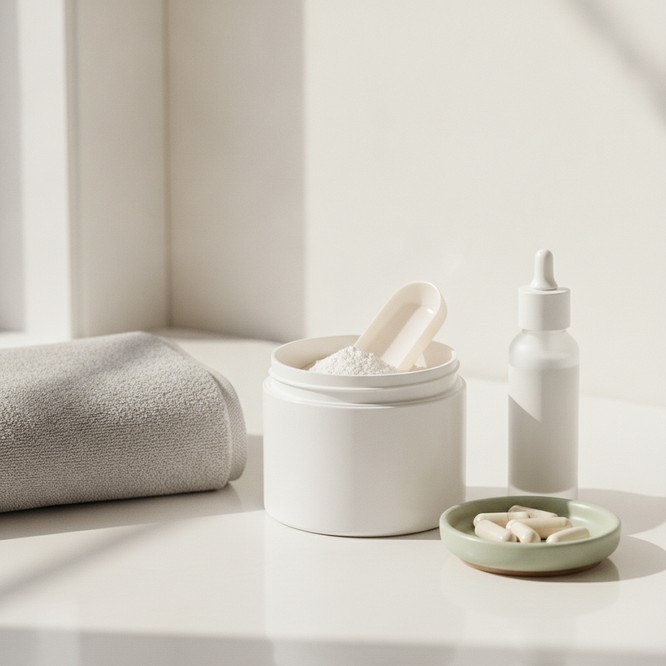
The clinic sees more collagen ingestibles arrive than the average pharmacy. First off, a giant tub of unflavored collagen powder a patient has been using since January, who insists he takes it after hearing a lady down the street rave about it. Then, an electric-green gummy pouch discovered inside the purse of another patient at the point of signing out.
So. Will it achieve anything useful, you think?
Flow Space interviewed Dr. Frank Agullo on precisely that subject, powders versus serums versus capsules versus gummies. Here is the full answer he gave.
Why Patients Start Looking in the First Place
Actually, the ads are not pushing the supplement. It is people standing in front of their mirror and watching it go bad there.
Below the epidermis entirely, collagen forms the framework for your skin and maintains the structure of the dermis. The production of collagen in both men and women generally begins to drop off in the early twenties, at rates not easily noticeable. Women experience a far more pronounced collagen decline during menopause.
“In the first five years after menopause, women lose roughly 25 to 30 percent of the collagen in their skin,” Dr. Agullo says. “That is not a lifetime figure. That is five years. It explains why so many patients tell me their skin seemed to change all at once.”
Lower your expectations. Your focus should be on retaining what you currently have. Rebuilding 25 percent of your dermal scaffolding from a scoop of powder is not a reasonable outcome.
Powder Is the Only Format With Real Human Data
That shelf? Four formats, and only one has clinical trials.
Studies usually range from around 2.5 to 10 grams of daily hydrolyzed collagen peptide consumption, which results in modest changes in the skin (improved hydration, improved elasticity) over 8 to 12 weeks. That means slightly better over the course of three months.
“Powder wins for a simple reason,” Dr. Agullo says. “A scoop delivers the dose the research actually studied. That turns out to be the hardest thing in the entire category.”
Capsules, Gummies, and the Sugar Problem
Capsule products still contain the peptides found in powder, but only a small fraction of the studied dosage. It takes so many capsules to actually ingest a dose that mirrors study requirements that it becomes infeasible for most people. Almost everyone who does take capsules ends up just popping two of them a day and feeling that they did enough, having ingested a small fraction of what the people in the study took. If capsules are your go-to, we instruct patients to read the label and consume the accurate dosage.
We specifically tell people to avoid the gummies. The reason should be stated out loud rather than just dissuading anyone with no rationale.
“The collagen content per gummy is low, and most of them carry added sugar,” Dr. Agullo says. “Sugar drives glycation, where sugar molecules bind to proteins and stiffen them. Collagen is one of those proteins. Glycated collagen is more brittle and less elastic. So the product delivers a little collagen while adding something that degrades the collagen you already have.”
| Format | Reaches the studied dose | Limitation | Our guidance |
|---|---|---|---|
| Powder | Yes | Mixing, taste | The format we recommend |
| Capsule | Rarely | Underdosing is common | Fine if the dose is real |
| Gummy | No | Low content, added sugar | Skip it |
| Serum | Not applicable | Cannot reach the dermis | Treat it as a moisturizer |
What a Collagen Serum Is Really Doing
A collagen serum seems as valid as any cosmetic and remains one of the most misunderstood items in modern beauty culture.
That molecule is enormous, and keeping molecules that size out is exactly what our outer skin layer does. Collagen only sits on top and holds moisture to the skin.
It does work, but it is slight and does not last. Your skin holds water so it looks temporarily fuller, and as soon as it is no longer in use, the temporary fullness goes away.
A topical focused on promoting collagen production would use retinoids, an effective vitamin C serum, or particular peptides as its main ingredient. These are the signals that encourage cells to produce more collagen. Simply printing the word “collagen” on the bottle’s front does not signify anything.
The Free Habit That Outperforms the Whole Aisle
As a minimum baseline measure, prior to any discussion of supplements, we question the patient about their usage of sunscreen.
El Paso has clear skies most of the year. UV exposure does more damage that we can control than anything else, and that includes diet, smoking, and pollution as the other controllable factors. UV rays trigger enzymes to destroy collagen while at the same time inhibiting any new collagen production. That is the reason sun exposure ages your skin most here.
Wear broad-spectrum sunscreen daily, and that will do far more for collagen preservation than any supplement. That is most of it. Use a retinoid nightly. Vitamin C daily. Eat enough protein. Get real sleep. Eat way less sugar (glycation again).
The Treatments That Do What Supplements Cannot
The minute someone wants direct collagen building rather than support for what is already there, either our MedSpa division or the surgical division will handle it.
Sculptra works by stimulating your body to make more collagen over a few months. Microneedling creates controlled injuries in the skin with a needle pen, and radiofrequency microneedling is more efficient than the traditional kind. Lasers work on the surface and just below it to improve texture, firmness, and quality of skin, and they give your daily skincare regimen something better to build on.
If the worry is tissue drooping, not the skin itself, then forget about collagen treatments. They will not fix it, not even close. It is purely structural loss and requires a conversation about that issue.
Dr. Agullo completed his plastic surgery fellowship at the Mayo Clinic, holding board certification from both the American Board of Plastic Surgery and the American Board of Surgery. For 13 consecutive years he has been ranked among the Top Doctors by Castle Connolly. He says part of his job involves being forthright about what a supplement will and will not do for a patient.
The Short Version
Take the powder daily. Give it three months to see whether you like it or not.
Gummies are silly. Use the serum as you would a moisturizer, which is what it basically is. And what is actually going to help the collagen in your skin, and keep the lines away, is sunscreen every single day.
“Collagen is a nudge, not a lift,” Dr. Agullo says. “It is not a facelift in a scoop. But it is worth something, and in this category that is a real distinction.”
#StayBeautiful.
Dr. Agullo’s comments appeared in Flow Space, “Powders, Serums, Gummies. What’s the Best Way to Get Your Collagen?” by Maggie Ryan, July 16, 2026. The surgeon’s own commentary version is on drworldwide.com, and the patient-education version is on agulloplasticsurgery.com.
Ready to Talk?
Want help building a skin plan? Or just a straight answer on whether a supplement will meet your goals? Let us walk you through it.
Call (915) 590-7900, text 1-866-814-0038, or book online at agulloplasticsurgery.com.
@RealDrWorldWide on Instagram, TikTok, and Snapchat, @Agullo on X, or @AgulloPlasticSurgery on Facebook.
