

“A shrunken follicle can still be revived with growth factors, medications, or therapies, but a lost follicle cannot be brought back.” That is the line Dr. Frank Agullo keeps coming back to with every patient who notices her hair thinning, and it is why he tells women not to wait. Plenty of them see more hair in the brush than they used to and worry, and at Southwest Plastic Surgery the first thing he sorts out is whether it is normal shedding or true hair loss.
Normal shedding is between fifty and a hundred hairs a day, which is usually unnoticeable. True hair loss is different. It exceeds the regrowth potential, and the hair that comes in is thinner, with worse texture and worse density, a process he calls miniaturization. The hair grows in three cycles, Dr. Agullo explains. There is anagen, when the hair is growing, catagen, which is a transition, and telogen, when the hair is resting or shedding. At the conclusion of each cycle, the hair sheds some.
The Common Causes the Team Looks For
The most common cause is female pattern hair loss, which is also called androgenic alopecia, the same major cause of hair loss in men. It has to do with genetics and a follicle sensitivity to DHT byproducts, which make the follicles shut down. In a woman, we don’t see a receding hairline like the one typically seen in males. Instead it happens at the top of the scalp and almost gives us a Christmas tree pattern.
Another common cause is emotional or physical stressors, which can push a large share of follicles into the resting phase. Right after a trigger like childbirth, surgery, major illness, rapid weight loss, or significant stress, the hair follicles go into this resting phase, and a few months later they all shed together. Third is hormonal imbalances, like low thyroid, where hair growth slows and shedding increases across the whole scalp. The fourth is nutritional deficiencies, like low iron, which is very common in many women, especially with heavy menses, and vitamin D deficiency can affect hair growth too. And the fifth is a physical reason, like when women pull their ponytails back too hard, which is called traction alopecia.
Menopause deserves its own mention. Estrogen is a very hair-friendly hormone. It keeps hair in its growth phase longer and supports healthy blood flow in the scalp. During menopause the production of estrogen falls dramatically, and as the estrogens drop, the androgens become more dominant. Those androgens then act on the genetically sensitive follicles at the top of the scalp, the same mechanism we see in female pattern hair loss, which is why so many women notice thinning right around midlife.
The Regenerative Scalp Program
The practice approaches the scalp the way it approaches the rest of the skin, by improving the environment the follicles live in. Microneedling of the scalp improves the microcirculation of blood flow to the hair follicles and has been shown scientifically to improve hair growth, often paired with regenerative growth-factor protocols. ElixirMD supports the nutritional side, addressing reversible contributors like iron and vitamin D.
A Candid Word on TCM-Inspired Approaches
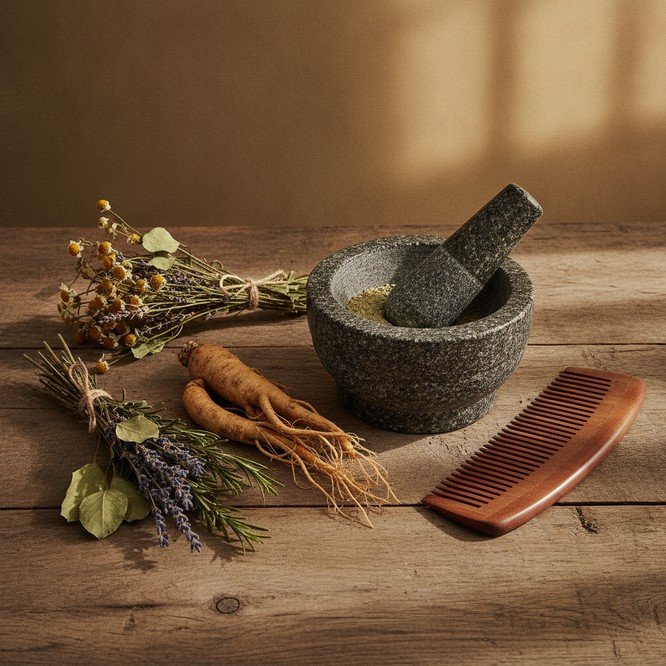
Patients often ask Dr. Agullo about traditional Chinese medicine, and he treats it seriously. Several TCM-inspired approaches line up with what the evidence supports, and they tend to share one mechanism: scalp circulation.
| Approach | What It Does | Evidence Note |
|---|---|---|
| Ginseng | Promotes scalp blood circulation | Well-researched, encouraging results |
| Angelica sinensis | Blood tonic, moves circulation | Lab studies show anti-inflammatory, circulatory benefit |
| Scalp acupuncture | Improves follicle microcirculation | Behaves much like microneedling |
| Scalp massage | Improves circulation | Proven to increase hair thickness and count |
| Polygonum multiflorum | Targets DHT, cells, circulation | Caution: a top reported cause of herbal liver injury |
Dr. Agullo is direct about Polygonum multiflorum. Most studies on it are in vitro and in animals, the risk of liver damage is real, and the reaction is unpredictable, especially with the raw root. As he puts it, a remedy being all natural does not mean it is automatically safe.
About Dr. Frank Agullo
Dr. Frank Agullo is the founder of Southwest Plastic Surgery in El Paso, Texas. He is double board-certified by the American Board of Plastic Surgery and the American Board of Surgery, a Fellow of the American College of Surgeons, completed a plastic surgery fellowship at the Mayo Clinic, and is a member of the International Society of Hair Restoration Surgery. He is a Clinical Associate Professor of Plastic Surgery at Texas Tech University Health Sciences Center Paul L. Foster School of Medicine and has been named a Castle Connolly Top Doctor for thirteen consecutive years.
Ready to Talk?
The most important step, Dr. Agullo says, is to see a physician as soon as hair loss begins, when therapies can actually help and reversible causes can be ruled out. Start with a scalp and hair assessment at Southwest Plastic Surgery.
For the surgeon’s editorial take on the evidence behind TCM and hair, see Dr. Agullo’s essay on drworldwide.com. For the clinical patient guide, see the companion post on agulloplasticsurgery.com.
Call (915) 590-7900, text 1-866-814-0038, or book online at swplasticsurgery.com. #StayBeautiful.
@RealDrWorldWide on Instagram, TikTok, and Snapchat, @Agullo on X, or @AgulloPlasticSurgery on Facebook.
