

When patients sit down at the long table in the front office at Southwest Plastic Surgery to discuss a planned operation, the question of the scar comes up almost every time. “What will it look like?” The answer is honest, layered, and based on a real program that runs from the first decision in the operating room to the last MedSpa treatment a year later.
Dr. Frank Agullo served as a principal investigator alongside Michael Sanchez, PhD on a 114-patient clinical study of the Planatome surgical blade, featured in MPO Magazine under the headline “Significant Reduction in Hypertrophic Scarring Seen With Planatome’s Surgical Blades.” The findings are part of the broader scar management program at Southwest Plastic Surgery, and the longer version of how that program runs in practice belongs here.
Why Scar Quality Is a Series of Decisions
Scar quality is decided at six moments and shaped by one variable nobody controls.
The variable nobody controls is the patient. Genetics, skin type, ancestry, and personal scar history all enter the room with her. Honest pre-operative counseling sets the realistic expectation.
The six decisions are the surgeon’s. The incision location. The orientation of the incision. The length of the incision. The blade. The closure plan, layered, with the right suture choice. And the post-operative scar care plan, including silicone, compression, sun protection, and any post-op laser or microneedling at the right interval.
A scar program that controls all six decisions and supports the patient on the seventh variable produces a measurably better final scar than a program that controls only one or two.
The Six Decisions, in Order
Incision Location
Where the scar is going to live is the first decision. Inframammary fold for breast augmentation. Suprapubic crease for tummy tuck. Periareolar for selected breast operations. Submental for selected facial procedures. The location is chosen for surgical access, for the geometry of the planned operation, and for the position where the scar will be least conspicuous in the patient’s natural clothing and posture.
Incision Orientation and Length
A scar that runs along a natural skin tension line heals quieter than a scar that runs across one. A scar of the right length, neither over-engineered for the operation nor compromised by an attempt to be artificially short, heals better than a scar of the wrong length.
Blade Geometry
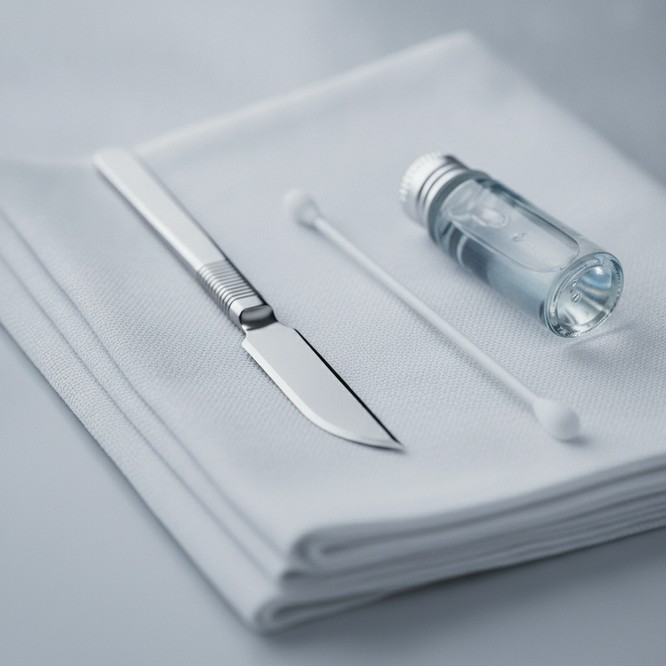
This is the decision the field has been quietest about, and the one the Planatome study addressed directly. A polished, sharper cutting edge produces a cleaner cut, a quieter inflammatory response at the wound edge, and, on the data, a measurable reduction in hypertrophic scarring. Dr. Agullo incorporates the Planatome blade into the operations where scar quality is most consequential, including tummy tuck, breast augmentation, mommy makeover, facelift, and any operation on a patient at elevated risk for hypertrophic scarring.
Closure Plan
A layered closure with deep-dermal sutures that absorb the tension before it reaches the skin, fine subcuticular sutures that approximate the dermal edges without strangulating them, and meticulous wound edge eversion is the foundation of a fine-line scar. The suture choice, the spacing, the depth, and the technique all matter. A great incision with a poor closure is a poor scar.
Post-Operative Silicone, Compression, and Sun Protection
The first three to six months are the active phase of scar formation. Daily silicone gel or sheeting, gentle compression where the anatomy allows, and disciplined sun protection are the patient-side variables that have been shown, repeatedly, to influence the final scar. The patient handout at Southwest Plastic Surgery is specific about products, timing, and frequency.
MedSpa Laser and Microneedling on Indication
For selected patients, the MedSpa layers in post-operative scar-management modalities at the appropriate intervals. Fractional non-ablative laser for early hypertrophic scar redness and pigmentation. Microneedling at the right interval to remodel the dermis along the scar line. Pulsed-dye laser for persistent vascularity. The MedSpa team coordinates the cadence with Dr. Agullo’s office, and the patient does not have to assemble the program from three separate providers.
How the Program Runs in Practice
| Phase | Setting | What Happens | Why |
|---|---|---|---|
| Pre-op | Consultation | Realistic scar expectation set | Genetics, skin type, anatomy, prior scars |
| Pre-op | Planning | Incision location, orientation, length set | Long-term scar geometry |
| Intra-op | Surgery suite | Planatome blade incision | Cleaner cut, quieter inflammatory response |
| Intra-op | Surgery suite | Layered closure with tension-balanced sutures | Foundation of a fine-line scar |
| Weeks 1 to 4 | Recovery | Silicone, compression, sun protection | Active phase scar modulation |
| Weeks 6 to 12 | Follow-up | Scar assessment, plan refinement | Catch early hypertrophy |
| Months 3 to 12 | MedSpa | Laser, microneedling on indication | Address vascularity, pigmentation, texture |
| Year 1+ | Final assessment | Long-term scar quality reviewed | Document the result and adjust as needed |
The phases run together as a single program. No part of the program is exotic. All parts of the program have to be done correctly to produce the final scar the patient hoped for at the consultation.
What the Planatome Study Showed, in Plain Terms
A 114-patient study evaluating the Planatome surgical blade showed a measurable reduction in hypertrophic scarring in the arm using the polished blade. Dr. Agullo served as a principal investigator on the study alongside Michael Sanchez, PhD. The trade industry coverage in MPO Magazine framed the reduction as significant. The result is internally consistent and clinically meaningful, and other investigators will be replicating it across other populations and operations in the years ahead.
The study is one input into the longer scar conversation, not the only input. The Southwest Plastic Surgery scar management program incorporates the finding at the first decision, the blade itself, and continues through the closure, the silicone, the MedSpa cadence, and the long-term follow-up.
About Dr. Frank Agullo
Dr. Frank Agullo is the founder of Southwest Plastic Surgery in El Paso, Texas. He is double board-certified by the American Board of Plastic Surgery and the American Board of Surgery. He is a Fellow of the American College of Surgeons. He completed a plastic surgery fellowship at the Mayo Clinic. He is a Clinical Associate Professor of Plastic Surgery at Texas Tech University Health Sciences Center Paul L. Foster School of Medicine and an Affiliate Professor at the University of Texas at El Paso. He has been named a Castle Connolly Top Doctor for thirteen consecutive years. He served as a Principal Investigator on the 114-patient Planatome surgical-blade clinical study, picked up by MPO Magazine and other trade outlets in early 2025.
Ready to Talk About a Planned Operation?
If a planned operation is on your mind and the scar is part of what you are weighing, the first conversation is a consultation at Southwest Plastic Surgery. The scar management program runs from the first decision in the operating room to the last MedSpa treatment a year later, and the program is part of the plan from the beginning.
For the surgeon’s editorial version of this conversation, see Dr. Agullo’s drworldwide.com essay, A Sharper Edge: A Surgeon’s Read on Blade Geometry and Scarring. For the clinical patient-facing version, see A Sharper Edge: How Blade Geometry Reduces Hypertrophic Scarring on agulloplasticsurgery.com.
Call (915) 590-7900, text 1-866-814-0038, or book online at swplasticsurgery.com. #StayBeautiful.
@RealDrWorldWide on Instagram, TikTok, and Snapchat, @Agullo on X, or @AgulloPlasticSurgery on Facebook.
