

Three weeks after surgery, a deep plane facelift patient sat down across from me at her two week visit. She lifted the hand mirror she had brought, looked at her own face, and asked the question I get more often than any other in that chair. “Why do I feel this good already?” The bruising she had braced for never really showed up. The fatigue lasted four days. She had slept the night of surgery and every night since.
I told her the truth. Part of it is the operation itself. A well-executed deep plane facelift releases the four retaining ligaments and repositions the soft tissue without tension, which means less swelling and less bruising than a traditional skin-tightening lift. Part of it is anesthesia and a meticulous closure. And part of it, increasingly, is what I add on the back end. A short, supervised peptide protocol that I have been refining for several years and that we now offer almost every surgical patient at Southwest Plastic Surgery.
More and often than not, when patients request I write peptide protocols, this is why. The recovery benefit is only one application for these molecules. Many patients use these molecules as part of an enhanced fitness and wellness program, for instance, they’ll use these peptides exclusively for support on their skin health, boost their immune and energy systems and ward off aging, which have nothing to do with post-surgery support. This specific article addresses only surgical recovery. If you wish to read my article concerning these peptides as a standalone benefit within a wellness program, please refer to the hyperlink found at the end of the document.
What a peptide actually is
A peptide is a short string of amino acids. The body makes thousands of them every day to send signals between tissues. Insulin is a peptide. Oxytocin is a peptide. Growth hormone is a peptide. The peptides I prescribe for surgical recovery are synthetic versions of molecules the body already makes, manufactured under cGMP pharmaceutical conditions, dosed precisely.
That is the part that matters. These are not herbal supplements. They are not hormones in the testosterone or estrogen sense. They are signaling molecules. The dose tells the body to do something it already knows how to do, just faster and more completely. Lay down collagen. Recruit fibroblasts to a sutured edge. Build new microvasculature. Restore mitochondrial energy.
Used well, with a physician selecting the dose and the duration, peptides accelerate the work the body was going to do anyway. Used poorly, with patients shopping the gray market on Instagram, they are a waste of money or a real safety problem. The peptides we prescribe at Southwest Plastic Surgery come from a US-based, cGMP-certified pharmacy with a certificate of analysis on every batch.
GLOW for face, KLOW for body
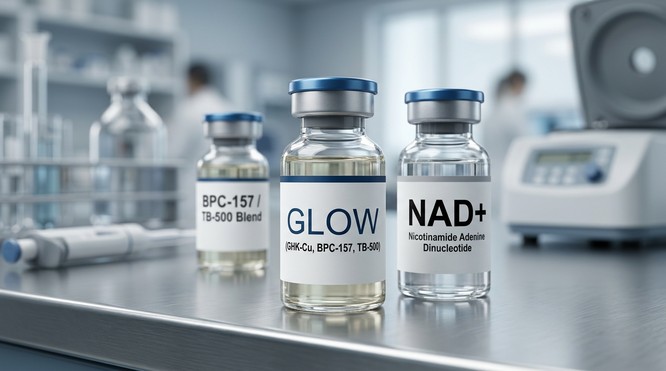
I prescribe two related peptide blends, depending on the operation. GLOW is a three-peptide blend (GHK-Cu, BPC-157, TB-500). KLOW is the same three peptides plus a fourth, KPV. The reason the menu has two versions is that face and body procedures call for different emphasis on the recovery side, and the right blend tracks the operation. The pharmacy compounds the peptides together in one vial, which makes it a single daily injection rather than three or four.
GHK-Cu is a naturally occurring copper tripeptide found in human plasma. The concentration drops as we age. It’s the same active compound in the copper peptide cosmetics you see at Sephora, with one important difference: injected, the peptide reaches the dermis directly at a controlled dose, instead of having to fight through the stratum corneum. Mechanistically, GHK-Cu activates more than three hundred genes involved in tissue repair. It signals fibroblasts to lay down new collagen and elastin. For a facelift patient, it is the part of the blend that helps a fresh incision heal flat and helps the skin in the operated zone look better six months out. The blue color of the solution comes from the copper. It is normal.
BPC-157 stands for Body Protection Compound. It is a fifteen amino acid peptide derived from a protein in human gastric juice. The mechanism that matters most for recovery is angiogenesis, the formation of new blood vessels at injury sites. New tissue cannot survive without blood supply. The body builds that supply slowly. BPC-157 accelerates it. The peptide also dampens local inflammation and supports tendon, ligament, and muscle repair. For a body procedure, this is the workhorse of the blend.
TB-500 is a synthetic analog of Thymosin Beta 4. It regulates a cellular protein called actin, which is essentially the rail system cells use to crawl across tissue. The simple way to put it: BPC-157 builds the new blood vessels, and TB-500 mobilizes the repair cells to use them. The two are synergistic, and the original published research on the pair came out of sports medicine, where elite athletes used the combination to come back from soft tissue injuries faster.
KPV’s a tripeptide (lysine-proline-valine) derived from alpha-MSH, and the job it does is anti-inflammatory. It works by inhibiting NF-kB, which is the master switch in the body for inflammatory gene expression. BPC-157 and TB-500 already dampen inflammation as a side effect of their main jobs, but KPV is the dedicated anti-inflammatory anchor sitting on top of that. For face procedures, where the inflammatory load is small and the priority is incision quality and skin remodeling, GHK-Cu’s doing most of the heavy lifting and GLOW gets the job done. For body procedures (BBL, gluteal fat grafting, tummy tuck, mommy makeover, breast surgery), the inflammatory field is much bigger, so I add KPV. That’s KLOW. Same once-daily injection from the same compounding pharmacy. The surgical field just gets broader anti-inflammatory coverage where it needs it.
I dose both blends subcutaneously, abdomen or thigh, once daily for the first three to four weeks after surgery. Most patients self-inject at home with a 30 gauge insulin syringe. We adjust at each post-op visit.
NAD plus, the mitochondrial side
NAD+ is a different molecule for a different problem. Technically it is a coenzyme rather than a peptide, but it sits next to peptides on the same prescribing menu and pairs with them well. The “nicotin” in Nicotinamide Adenine Dinucleotide is from vitamin B3 etymology. It has nothing to do with cigarettes, a clarification I make at the start of every consultation.
NAD+ powers the mitochondria, the cellular machinery that makes energy. It also fuels sirtuins, a family of enzymes involved in DNA repair. Levels drop with age, with stress, and with illness. Surgery is a stress. Recovery is a period of accelerated cellular work. Adequate NAD+ is the cofactor that work needs.
We primarily use at-home self-injections. Patients can go home with one month total supply. You’re supposed to split the doses evenly between morning and night in two separate injections a week apart. I usually inject patients two times per week for a total of eight doses. A total of 62.5 mg each time to recover nicely over the four weeks post surgery. Patients typically have minimal discomfort and it’s convenient for at-home self use. The constant infusion will ensure constant mitochondrial support throughout this crucial period in your healing.
If you do decide that you want to add an IV option in addition to the self injections, Southwest Plastic Surgery does offer a NAD+ and Glutathione drip. One IV infusion a few days before surgery and another one about a week after the surgery. One before surgery primes the body’s mitochondria so that we can have as much support as possible for the body going through stress from the surgical trauma. One after surgery helps the body as we head into the critical phase in the healing and repairing processes of the body’s cells. Glutathione is added slowly over time as the IV infusion slows. Glutathione is an antioxidant peptide which is useful in liver Phase 2 cleansing and it also helps clear leftover anesthesia and metabolites that come from the surgery.
One IV complication to note: Run the NAD+ infusions too quickly, the NAD+ will cause chest tightening, nausea, flush and a hot burning sensation. The reaction to IV NAD+ is dose and speed related. Run the NAD+ drip at the recommended rate, the NAD+ (500 mg) will usually be administered at over two to three hours followed by 1000-1500 mg of Glutathione at a push rate of five to 15 min, the entire time the infusion is happening is comfortable for the patient. Our medspa nurses are excellent in titrating rate to patient comfort. Asthma patients should be watched carefully during the glutathione push as we’ve had a patient or two experience bronchospasm.
How the protocol matches the procedure
The recovery protocol is not a single template. It shifts with the operation.
| Procedure | Blend | Cycle | NAD plus |
| Facelift, neck lift, blepharoplasty | GLOW | 3 to 4 weeks daily | 250-500 mg SQ/IM monthly, divided 2x/week. Optional IV pre-op + post-op. |
| BBL, gluteal fat grafting, body contouring, tummy tuck, mommy makeover | KLOW | 4 to 6 weeks daily | Same SQ/IM schedule, sometimes extended through month two. Optional IV pre-op + post-op. |
| Breast surgery, including Motiva Preserve augmentation | KLOW | 3 to 4 weeks daily | 250-500 mg SQ/IM monthly, divided 2x/week. Optional IV pre-op + post-op. |
| Combination procedures (face plus body, multi-site) | KLOW | Longer cycle, individualized | Standard SQ/IM schedule, IV often included. |
| Isolated minor procedures (lip lift alone, blepharoplasty alone) | Often none | Patient-specific | Patient-specific |
Where the MedSpa fits, and where it does not
The Southwest Plastic Surgery MedSpa runs the IV NAD+ plus glutathione infusions, the subcutaneous NAD+ refills, and the peptide pickup and education for patients on a GLOW or KLOW protocol. The MedSpa nurses also handle the technique training for self-injection at the post-op visit, including site rotation and disposal.
Two things the MedSpa does not do, and that I want to be plain about. The MedSpa does not adjust the prescribed dose without me. The MedSpa does not add additional peptides on top of GLOW or KLOW based on something a patient read online. Both of those decisions live with me as the prescribing physician. That is not a service limitation. That is a safety floor.
We integrate the peptide protocol with the rest of what the MedSpa offers in the same recovery window. Lymphatic massage, ElixirMD post-op recovery, scar protocols. The peptide piece is not a replacement for any of those. It is an addition.
Who is a candidate, and who is not
The starting question is whether the patient wants the smoothest possible recovery, will tolerate four to six weeks of daily self-injection, and has a medical history that supports the protocol. Most do.
Active malignancy is a contraindication for growth-factor-adjacent peptides because we do not want to support an undiagnosed tumor. Pregnancy and breastfeeding are off the protocol. Active infection is a temporary contraindication and we delay until cleared. Patients on therapeutic anticoagulation receive adjusted dosing in coordination with their cardiologist. Patients with a personal cancer history, even if treated and clear, get a longer conversation and often an oncology clearance before we proceed.
The cautious side
Peptides aren’t actually FDA-approved new drugs, as most physicians use compounded peptides from US 503A pharmacies. This practice is legal and valid, however, it also contributes to a black market rife with peptides of unspecified origin, unverified dosage and questionable sterility. As a peptide is an injectable sterile medication, purchasing it from a source on Telegram represents a risky decision about one’s well-being and is a lawsuit waiting to happen. I personally use a U. S. -based, cGMP-certified pharmacy, which provides a certificate of analysis with each prescription. The price is higher than that of the black market. You’re paying for the quality differential that this represents.
The second rule, and the one patients sometimes struggle with: a compounded peptide blend is calibrated. Adding random fourth and fifth peptides on top of GLOW or KLOW because of a podcast is not optimization. It is a way to give yourself an unintended hormonal or hematologic problem. If a patient wants to expand the protocol, that conversation happens in my office, with new prescriptions written for the new molecules.
Two more reads
For the editorial, shorter version of this post, with the Vogue-side voice rather than the practice-side voice, see After the Operating Room: The Peptide Stack My Patients Recover On on drworldwide.com.
For the longer, more clinical version, with deeper mechanism, dosing, and contraindications, see Peptides for Plastic Surgery Recovery: A Clinical Guide to GLOW and NAD Plus on agulloplasticsurgery.com.
Why choose Dr. Agullo for a peptide-supported recovery?
Double board-certified, American Board of Plastic Surgery and American Board of Surgery. Fellow of the American College of Surgeons. Mayo Clinic plastic surgery fellowship. Clinical Associate Professor of Plastic Surgery at Texas Tech University Health Sciences Center, teaching the same techniques I use every week. Affiliate Professor at UTEP. Castle Connolly Top Doctor for thirteen consecutive years. The peptide protocol is prescribed by me, sourced through a US cGMP-certified compounding pharmacy, and integrated into a recovery plan refined operating on local, national, and international patients for the last fifteen years.
Ready to talk?
The right time to start the recovery conversation is during the surgical consultation, not the day before surgery. Schedule a consultation at Southwest Plastic Surgery and we will review your anatomy, the operation you are considering, your medical history, and we will decide together whether peptides belong in your plan. If they do not fit, I will say so. If they do, you will leave the consultation with a written protocol, a price, and a timeline. Call (915) 590-7900, text 1-866-814-0038, or book online at agulloplasticsurgery.com. Follow along on social at @RealDrWorldWide on Instagram, TikTok, and Snapchat, @Agullo on X, or @AgulloPlasticSurgery on Facebook. #StayBeautiful.
