

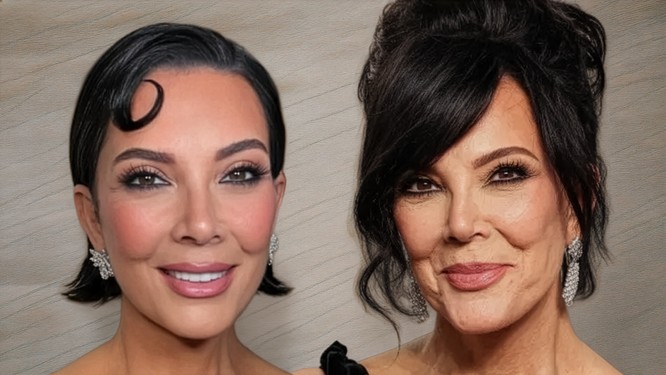
For the past two months, almost every facelift consultation at our El Paso office has begun the same way. The patient pulls out her phone, turns the screen toward Dr. Frank Agullo, and there are Kris Jenner’s two photos. The Vogue Arabia cover from August on the left, and a candid shot from the past few weeks on the right. The patient asks the same thing every time. What happened to her face.
It turns out to be a really useful question to chase down. Because the answer is the same answer that decides every facelift, ours included. Which technique. On whose face. At what age.
We grabbed Dr. Agullo between two surgeries last week and asked him to walk us through it the way he walks his consultation patients through it. The transcript below is lightly cleaned up.
Last summer’s reveal, and the year that followed
Last August, Kris Jenner appeared on the cover of Vogue Arabia and confirmed she had had a second facelift. The before-and-after circulated for weeks. One post on X asking who her surgeon was racked up tens of thousands of likes. Pundits called it the best celebrity facelift in a hundred years. She is seventy. Some of the photos made her look closer to forty.
Twelve months on, the headlines have flipped. Outlets are reporting that her facelift is “slipping” and that she has been asking her team about a revision. The same press cycle that crowned the result has started running comparisons against Denise Richards, who is fifty-five and looks, by any account, terrific a year out from her own facelift.
Asked what he sees in the recent photos, Dr. Agullo doesn’t reach for the gossip frame.
“None of this is unusual,” he told us. “What you’re watching happen to her face in real time, on the internet, is the textbook arc of a SMAS-based facelift on a seventy-year-old. It’s actually the best public-education moment we’ve had on facelift technique in years, and patients should pay attention.”
The question patients should be asking, and almost never do
Walk into any of our facelift consultations and you will hear the same first three questions. How much. How long is recovery. Will I look pulled. All fair, all important. None of them, in Dr. Agullo’s view, is the question that matters most.
“What I want patients to ask me,” he said, “is ‘what plane do you operate in.’ Because the plane decides almost everything else. How long the result lasts. How natural it looks at year five. Whether you’re still happy at year ten.”
There are essentially two planes a facelift can be done in.
A SMAS-based facelift works on a layer just under the skin called the SMAS (short for Superficial Musculoaponeurotic System). The surgeon either folds it on itself (plication) or removes a strip and stitches the cut edges back together (SMASectomy). Done well, it gives a clean three-month result. It has been the workhorse facelift for decades.
A deep plane facelift works underneath that layer. The surgeon dissects beneath the SMAS, releases the four retaining ligaments that anchor the face to the skull (zygomatic, masseteric, mandibular, platysma), and lifts the entire composite of skin, SMAS, fat, and muscle as one piece. Nothing gets pulled on. Nothing closes under tension. And because nothing is stretched out at closure, nothing relaxes back over the next two years. The published longevity data on deep plane results runs ten, twelve, sometimes fifteen years.
Kris Jenner’s surgeon performed a SMAS-based operation. Specifically, a lateral SMASectomy paired with a deep neck lift. Reputable surgeon. Well-executed work. But not the same operation as the deep plane Dr. Agullo performs.
The honeymoon phase
One of the reasons Kris Jenner’s reveal looked as breathtaking as it did, and one of the reasons her current photos look as different as they do, has nothing to do with her surgeon. It has to do with what Dr. Agullo calls the honeymoon phase of every facelift.
“Every facelift looks incredible at three months,” he said, almost cheerfully. “I mean every single one. It’s not a bug, it’s a feature, but patients need to know about it before surgery so they don’t fall in love with a result that isn’t actually their result yet.”
Three months postoperatively, the swelling has not finished going down. The skin is still tight from the closure. The deep tissues are healing in a position that is, frankly, just slightly tighter than where they will end up. Add a Vogue cover team, a top-tier glam squad, and the careful retouching that comes with a celebrity reveal, and you get the honeymoon face. Which, Dr. Agullo says, is real but not durable.
“The face you live with shows up at twelve to eighteen months. Swelling is gone, skin has relaxed, the tissues have settled where they’re going to settle. If your operation was right for your anatomy, the twelve-month face barely differs from the three-month face. Rested. Younger. Still you.”
When the operation isn’t right for the anatomy, twelve months is when the gap shows up. Volume that was masking a structural problem retreats. Skin that was tight relaxes. The midface, which is heavier than people think, starts dropping again. Which, in his read, is exactly what is on display in the recent Kris Jenner photos.
The midface, the malar bags, and what a SMAS technique can’t do
Asked to point at specifics, Dr. Agullo focused us on the midface.
“Look at her lower face and her neck. Both still meaningfully better than they were preop. Her jawline is cleaner. The platysmal bands are quiet. That part of the operation worked, and it’s actually pretty good work for the technique used.”
“Now look at her cheekbones. The malar bags, the rounded fullness sitting on top of the cheekbones, are right there. Two of them. Round, glossy, hard to unsee. They were briefly hidden by swelling and a tight closure at the reveal. Now the swelling is gone, the closure has relaxed, and the bags are back.”
He’s quick to say this isn’t a mystery and isn’t an error in any judgmental sense.
“It’s anatomy. A lateral SMAS technique pulls on the side of the face. It does great work in the lower third. But it does not reposition the malar fat pad, which is the cushion of fat that gives a cheekbone its shape and keeps the area from collapsing into a pouch. The deep plane does. We release the zygomatic ligament, free up the malar fat pad, and lift the whole construct as part of the composite flap. The endoscopic ponytail lift gets to the same anatomy through tiny incisions inside the hairline. If you skip the malar release on a face that needs it, you get exactly the trajectory we are watching.”
Seventy is not fifty
The Denise Richards comparison the press has run with isn’t really a fair fight, in Dr. Agullo’s view.
“Richards is fifty-five. Her surgeon took her into the deep plane. Fifteen years younger plus a more durable operation equals a result that, a year out, still looks like the result. Kris is seventy and had a SMAS-based operation. The math was hard before anyone scrubbed in.”
Why does age matter so much? Because tissue at seventy doesn’t behave like tissue at fifty. Less elastin. Thinner collagen. Less of the deep ligamentous architecture that holds a result in place. Run the same operation on a fifty-year-old and a seventy-year-old by the same surgeon on the same day, and the fifty-year-old will hold longer. Every plastic surgeon knows this. Most of them, out of professional politeness, don’t say it out loud.
Dr. Agullo will say it.
“At seventy, the technique you choose is doing most of the work. A SMAS-only operation might give you a year or two of looking like the day after the bandages came off, then a steady drift back to where you started. A deep plane, on the same patient, holds for ten to fifteen years. Those aren’t my numbers. Those are what the longitudinal studies show.”
Where MedSpa fits, and where it doesn’t
A question that comes up constantly in our consultations, especially with patients in their forties and fifties: can we just keep doing MedSpa treatments instead of surgery? Tox, fillers, lasers, Morpheus, BBL Forever Young.
Dr. Agullo’s answer is honest and a little nuanced.
“Look, our MedSpa side has real tools. Botox, hyaluronic acid fillers, BBL Forever Young, laser resurfacing, Morpheus8 radiofrequency microneedling. They earn their place. For a forty-year-old face they can buy you years before surgery is the answer. But none of them reposition deep tissue. They treat surface, volume, skin tone. So when somebody tries to use them as a permanent stand-in for a facelift on a face that has actually descended, what you get is a face that looks fuller. Not younger. Puffy cheeks, no jawline, an upper lip that nobody asked for. The filler tax, paid one too many times.”
Sequencing matters, in his telling.
“Forties and early fifties, lean MedSpa. Keep the skin in good shape. Be sparing and precise with injectables. When structure starts to slip, that is the moment to have a surgery conversation, and you want it before the slipping gets a head start. After the facelift, MedSpa picks back up. Skin care. Energy-based treatments to keep the result clean. The right cadence of small injectables, not a wall of them.”
That sequencing is something our surgical team and MedSpa team plan out together for facelift patients. It is part of why people fly into El Paso for the long arc of facial aging, not just for one operation.
What to ask any surgeon you consult, anywhere
We asked Dr. Agullo what questions he wishes patients would put to every surgeon they sit with, his own consults included.
He gave us four.
What plane do you operate in. SMAS, deep plane, composite. The honest answer matters more than the polished marketing language on a website.
How often do you do a deep plane facelift versus a SMAS-based operation. A surgeon who does the deep plane every week is a different surgeon from one who does it occasionally.
Where did you train for it. The deep plane and the endoscopic ponytail lift are unforgiving operations with a steep learning curve. A weekend cadaver course is not the same as a structured intermediate-and-advanced program.
Can I see your one-year, two-year, and five-year follow-up photos. Not three-month reveals. Three-month reveals are the honeymoon. The deliverable is the long view.
About Dr. Frank Agullo, MD, FACS
Dr. Frank Agullo is the medical director of Southwest Plastic Surgery in El Paso. He is double board-certified by the American Board of Plastic Surgery and the American Board of Surgery, a Fellow of the American College of Surgeons, and a Mayo Clinic plastic surgery fellowship alum. He serves as Clinical Associate Professor of Plastic Surgery at Texas Tech University Health Sciences Center and Affiliate Professor at the University of Texas at El Paso. He has been named a Castle Connolly Top Doctor for thirteen consecutive years. His advanced facelift training includes the Ponytail Academy intermediate course in Pittsburgh and the advanced course in Santa Monica. Roughly sixty percent of his facelift patients fly into El Paso from out of town.
For two more reads on the technique conversation above, both written by Dr. Agullo himself:
The editorial take is on his personal blog, drworldwide.com: After the Honeymoon: Kris Jenner, the SMAS Plication, and the Difference a Decade Makes.
The deeper clinical version is on his medical-grade blog, agulloplasticsurgery.com: After the Honeymoon: What Kris Jenner’s Facelift Actually Tells Us About SMAS, Deep Plane, and Time.
Schedule a facelift consultation at Southwest Plastic Surgery
Southwest Plastic Surgery is the El Paso practice of Frank Agullo, MD, FACS. To schedule a facelift consultation with Dr. Agullo or to talk to our MedSpa team about non-surgical options, call (915) 590-7900, text 1-866-814-0038, or book online at agulloplasticsurgery.com/appointments. Follow Dr. Agullo at @RealDrWorldWide on Instagram, TikTok, and Snapchat, @Agullo on X, or @AgulloPlasticSurgery on Facebook. #StayBeautiful
