

Dr. Frank Agullo: “Unfortunately, I am seeing a lot of these come from unlicensed sources. A lot of people are buying these from their trainers, or at the gym. But I think the greatest amount of people are buying them from the internet, from unknown sources. And that is where the real danger lies.”
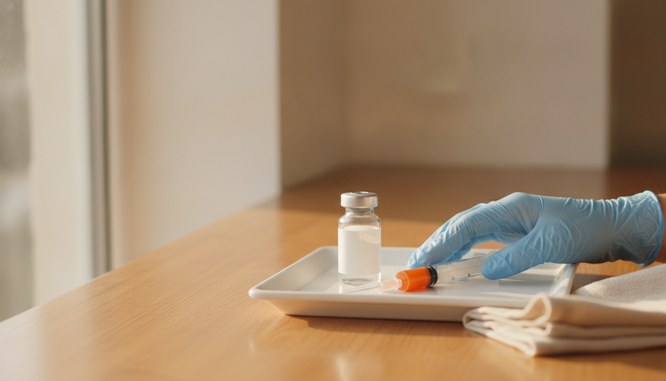
MDLinx asked him about it for a feature on what happens when do-it-yourself peptide injections land patients in a clinic. His first move is to ask for the vial and the syringe.
“Most patients have never been told that ‘compounded’ and ‘FDA-approved’ are different things, and once they see that the label makes no claim about what is actually inside, the conversation changes.”
What Patients in El Paso Are Injecting
Which peptides are patients self-injecting, and where are they buying them?
Dr. Agullo: “The most common peptides I’m seeing patients self-inject are the stacks. The Wolverine stack, the Glow stack, and the KLOW stack.”
“I can also say that NAD+ is a very popular self-injected substance, even though it actually is not a peptide.”
Wolverine is BPC-157 and TB-500. Glow adds GHK-Cu. KLOW adds KPV on top of that; it is a different stack from Glow, however alike they sound. What the individual peptides are is covered in the practice’s what are peptides post.
The Label Check: Pharmacy-Compounded Versus “Research Use Only”
Southwest Plastic Surgery prescribes compounded medications, including compounded GLP-1s through its medically supervised weight loss program.
What is the difference between a compounded product from a 503A or 503B pharmacy and a “research use only” vial?
Dr. Agullo: “A compounded product from a 503A or 503B pharmacy is made under FDA-regulated conditions, sterility-tested, and labeled with a verified dose and purity. By contrast, any vendor, on the internet or anywhere else, can simply stamp ‘for research purposes only’ on a vial. That label carries no authority and doesn’t really mean anything, but it may give the buyer a false sense that the substance is authentic. On top of that, it actually clears the vendor of any responsibility, because the vial says ‘for research purposes only,’ meaning the user should not be self-injecting that substance in the first place. It was never intended or approved for injection into humans, and you have no assurance of what’s actually in it, whether the dose is accurate, or whether it was made under sterile conditions.”
One Case, Anonymized
Have you treated a real injection-site complication?
Dr. Agullo: “Yes, I’ve had a patient, a male in his 30s, who was self-administering the Wolverine stack, which he purchased on the internet. He came in with a red area in the buttock, with fevers and night sweats. When we examined him, he had an area that was boggy. We went ahead and lanced it and removed purulent discharge, and we started packing it for about a week, with antibiotics. The cultures came back as Staph aureus. Luckily, it was not methicillin resistant, which would be MRSA. And the patient recovered and healed well.”
“We did note on that examination that he also had some nodules throughout previous injection sites. This could have been due to the substance not being pure or completely aseptic. The nodules could also be from the injection technique itself, the aseptic technique, or the body’s own response creating fibrosis.”
“I have seen many cases like this, so this is not an isolated case. And the common denominator in all these cases has been that the substances or the peptides have been acquired through unlicensed sources. To avoid this, I recommend obtaining all peptides from a certified pharmacy through your physician.”
The 24-Hour Versus Day-Five Rule
“I also tell them what a normal injection site looks like at 24 hours versus what should send them to a physician the same day: expanding redness, warmth, fever, or a nodule that is still growing at day five.”
How Peptides Are Handled at Southwest Plastic Surgery
Dr. Agullo has described the practice’s approach in the trade press: “We put them on a protocol. They visit monthly, get bloodwork done every 3 to 6 months and we titrate their medication as we go, over a period of years.”
The details are in the practice’s peptide therapy post. Patients asking about newer weight-loss peptides can read the retatrutide post, and patients injecting fillers or neurotoxins bought online should read the DIY injectables post, which covers that separate problem. The Everyday Health Saxenda post covers GLP-1 access and the compounded GLP-1 safety note.
Why Dr. Agullo
Dr. Agullo is certified by the American Board of Plastic Surgery and the American Board of Surgery, completed his plastic surgery fellowship at the Mayo Clinic, and serves as Clinical Associate Professor of Plastic Surgery at Texas Tech University Health Sciences Center. He has been a Castle Connolly Top Doctor every year from 2014 through 2026.
Schedule a Consultation
If you are already injecting something you bought online, bring the vial. To ask about peptide therapy at Southwest Plastic Surgery, call (915) 590-7900, text 1-866-814-0038, or book at https://www.swplasticsurgery.com/contact/. #StayBeautiful
Find Dr. Agullo at @RealDrWorldWide on Instagram, TikTok, and Snapchat, @Agullo on X, or @AgulloPlasticSurgery on Facebook.
