

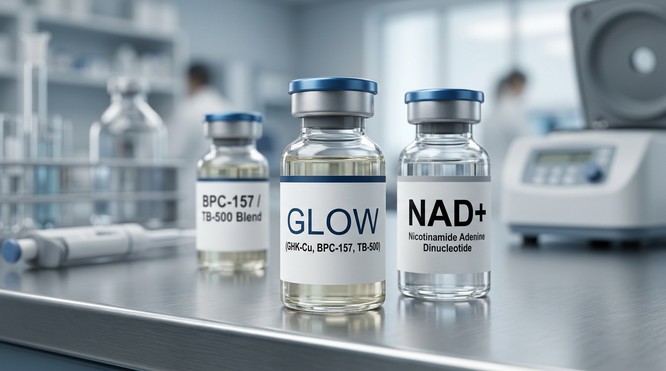
Patients at Southwest Plastic Surgery have asked about peptides for years, usually in the same breath as a question about where they come from and whether they are legal. This week the FDA moved that conversation forward.
On July 23 and 24, the FDA’s Pharmacy Compounding Advisory Committee met to decide whether seven popular peptides should be added to the list of ingredients that licensed compounding pharmacies are allowed to prepare. By the end of the first day, the panel had recommended four of them: BPC-157, KPV, TB-500, and MOTS-c.
For a practice that runs a physician-supervised peptide wellness program, that is news worth explaining carefully. So we asked Dr. Frank Agullo, the double board-certified plastic surgeon who built the program, to walk through what happened and what it changes.
What the Committee Decided
The committee reviewed seven peptides across two days: BPC-157, TB-500, KPV, MOTS-c, Semax, Epitalon, and DSIP. The first four were recommended for the 503A bulks list, the FDA’s roster of raw ingredients that state-licensed compounding pharmacies may use to prepare medications for individual patients with a prescription. The votes were close: 8 to 6 for BPC-157, KPV, and TB-500, and 7 to 5 for MOTS-c.
Notably, the panel voted against the advice of the FDA’s own scientific reviewers, who concluded that none of the seven peptides had enough human evidence behind it to qualify. The remaining three peptides were taken up on the second day, with results still being reported.
Dr. Agullo reads the outcome as a net positive. “I think this is overall a positive thing. I understand why the career reviewers said no. Their job is to make decisions based on evidence in large human trials, which are nonexistent as of now. But compounding was never meant to require approval-level data. That was left to the discretion of doctors, whether the treatment should be used.”
He points to the last attempt to restrict these substances as the reason. “There was a crackdown in 2023, but these restrictions really were not effective. They didn’t reduce the demand. What happened is that patients would go to Instagram or Telegram to acquire their peptides. So the real question wasn’t peptides or no peptides. It was really about regulated peptides or gray market peptides. Given that point of view, I think the panel made the right decision.”
He is careful to separate two things, though. “The committee did not vote on whether these peptides work. It voted on who is allowed to make them. Those are different questions, and patients deserve to have them answered separately.”
Why This Matters for Patients
Most peptides in circulation today are not bought from pharmacies at all. They are purchased over the internet, from social media sellers and unknown websites, where the product is neither tested for sterility nor reliably labeled. That gray market grew quickly as the earlier restrictions took hold, pushing several effective peptides out of licensed pharmacies without doing anything to satisfy the demand patients still had for them.
Dr. Agullo has been blunt about this with his own patients. “I tell patients all the time, do not buy peptides from Instagram, Telegram, or the internet. If you want to use peptides, you should really be getting them from a certified, licensed pharmacy that’s going to do the appropriate testing, and that’s going to have the actual dosing and the actual ingredients necessary.”
When someone arrives already using a peptide bought online, his first step is not a lecture. “I’d like to see the vial the patient has, where it came from, what doses, and any certificate of analysis. Most of the time, these are nonexistent. At this point, my greatest concern is not what peptide the patient is using, but whether there’s anything in the bottle at all. Most of the time there’s no sterility testing, and no guarantee that the label matches the ingredients. You’re really just injecting a mystery, and it could just be water.”
If the FDA follows the committee’s recommendation, the practical change is that peptides like BPC-157 could be prescribed by a physician and prepared at a licensed US compounding pharmacy, with testing standards, inspections, and accountability. That is the model Southwest Plastic Surgery has always insisted on. Every peptide dispensed through the practice comes from a US pharmacy operating to cGMP standards, with a certificate of analysis for every batch.
What Each Peptide Does, in Plain English
| Peptide | Plain-English role | Recommended? |
|---|---|---|
| BPC-157 | Tissue and tendon repair signaling | Yes, 8 to 6 |
| TB-500 | Cell migration and repair support | Yes, 8 to 6 |
| KPV | Inflammation calming | Yes, 8 to 6 |
| MOTS-c | Cellular energy and metabolism | Yes, 7 to 5 |
These four are repair-and-recovery molecules, which is exactly the role three of them already play in the practice. In Dr. Agullo’s surgical recovery protocols, they support healing within a defined window after an operation, and then the course ends. The two peptides at the heart of the practice’s day-to-day wellness work, GHK-Cu for skin quality and NAD+ for cellular energy, were never part of this week’s vote. Both remain available through the med spa exactly as before.
What Has Not Changed
Two things deserve a clear statement, because headlines tend to blur them.
First, no peptide was approved as a drug this week. An advisory committee recommendation is advice. The FDA makes the final decision through a formal rulemaking process, and the agency’s own reviewers opposed adding any of the seven. The recommendation could be adopted, modified, or declined.
Second, the evidence base did not change, and for Dr. Agullo that is the point that matters most. “Really the most important thing moving forward is actual human data to back up what we’ve observed in animal studies and self-reports.” The research on these peptides remains early, much of it extrapolated from animal work, and a vote does not change what has or has not been studied.
As for the practice itself, he expects little to change day to day. “There’s really not much change. This is what we’re doing already. We prescribe peptides that have high-quality certification and quality control measures, with a certificate of analysis with every batch. Really, the biggest gain here is that the quality pharmacies become legal, and the gray market starts losing ground.”
That is why every peptide protocol at Southwest Plastic Surgery starts with a medical consultation, a full history, and a physician-written plan with a beginning and an end, rather than an open-ended subscription.
The Practice Behind the Program
Dr. Agullo is certified by the American Board of Plastic Surgery and the American Board of Surgery, completed his plastic surgery fellowship at the Mayo Clinic, and serves as Clinical Associate Professor of Plastic Surgery at Texas Tech University Health Sciences Center. He has been a Castle Connolly Top Doctor for thirteen consecutive years, and he has been quoted in the national press this year on the risks of unregulated peptide sourcing. The peptide program at Southwest Plastic Surgery is run with the same medical rigor as a surgical consultation, because it is one.
Talk to Us About Peptides
Curious whether peptide therapy fits your goals? Already taking something and unsure what is actually in it? Bring the vial to your consultation. The team will give you an honest read, and if a protocol is not right for you, you will hear that too.
Call (915) 590-7900, text 1-866-814-0038, or book online at agulloplasticsurgery.com. #StayBeautiful
For more on this week’s vote, read Dr. Agullo’s first-person analysis, The FDA Just Blinked on Peptides on drworldwide.com, and the patient-focused explainer BPC-157 Just Cleared an FDA Hurdle on agulloplasticsurgery.com.
@RealDrWorldWide on Instagram, TikTok, and Snapchat, @Agullo on X, or @AgulloPlasticSurgery on Facebook.
