

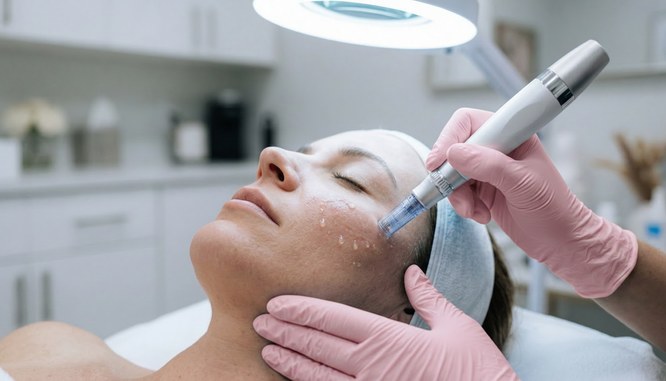
For about five years, every Morpheus8 appointment at our El Paso MedSpa started the same way. Patient checks in. Vitals. A small tube of blood drawn from the inside of the elbow. The tube goes into a centrifuge. Twelve minutes later, our team paints platelet-rich plasma onto freshly microneedled skin. Patient leaves with a small bandage on the inner arm and (usually) a glow.
Then, sometime around the start of the year, the routine changed. The blood draw disappeared. The bandage on the arm disappeared. Patients started asking the obvious question. What happened to the PRP.
We took the question to Dr. Frank Agullo, the medical director of Southwest Plastic Surgery. He has been running this MedSpa long enough to remember when PRP was the new exciting thing nobody had heard of. He gave us the long answer.
The shorthand version
“PRP works,” Dr. Agullo told us. “It still works. We did not stop because PRP failed. We stopped because something cleaner showed up. Recombinant pure PDGF, in a controlled dose, with no blood draw. The brand we use is Ariessence pure PDGF+.”
The longer version of that explanation is worth a few minutes. The MedSpa team has been getting a version of this question every week since the change, and the answer is genuinely interesting once a patient takes the time to hear it.
What is PDGF, in plain English
The body has a small set of proteins it relies on to handle injury. When tissue gets cut, scraped, microneedled, lasered, or otherwise irritated, platelets release a cocktail of proteins called growth factors. PDGF is one of the leaders of that cocktail. It calls in the cells that lay down new collagen. It helps the body build the new blood vessels healing tissue needs. It is, in a real sense, the molecule the dermis is asking for at the exact moment it just got injured.
For most of the past decade, the way clinicians delivered PDGF to skin in an aesthetic context was indirect. They drew a tube of patient blood, spun it down in a centrifuge, and applied platelet-rich plasma on freshly microneedled or lasered skin. PDGF rode along, mixed with several dozen other proteins, in concentrations that varied with the patient and the technician.
Recombinant pure PDGF is what you get when a lab makes only the PDGF molecule itself. The protein is produced in cultured cells from a human gene, then purified to a single active species. The dose is the same in every patient. There are no human-derived components in the formulation. The Ariessence product pairs the recombinant PDGF with a hyaluronic acid serum and is mixed in the treatment room in under a minute.
“Same idea as PRP,” Dr. Agullo said. “Just a cleaner version of the same idea. The thing the body was asking for, in a controlled amount, every time.”
Why right after a microneedling session, and not as a take-home serum
Patients ask if Ariessence is something they can buy and apply at home. The answer is no, and the reason is mechanical.
PDGF on intact skin sits on top of the stratum corneum. The stratum corneum is the skin’s outer barrier. It is highly effective at keeping large molecules out. A growth factor in a jar at home is mostly a moisturizer with an interesting label.
The post-procedure window changes that. After Morpheus8, RF microneedling, fractional laser, or a medium-depth peel, the skin has thousands of microchannels open into the dermis for a finite period. The treatment area is briefly ready to receive what gets applied to it.
“That window closes inside a couple of hours,” Dr. Agullo said. “Whatever I put on the skin in the first ten minutes is the second half of the procedure. We do not waste it on water.”
The study patients keep asking about
In September 2025, Michael Gold and colleagues published a randomized controlled trial in the Journal of Cosmetic Dermatology. Healthy adults between thirty and sixty got a single Morpheus8 RF microneedling session. They were randomized to receive either bland Aquaphor or topical recombinant pure PDGF-BB immediately after. A blinded evaluator graded them at seven and thirty days using a global aesthetic score, the Canfield Visia imaging system, and patient experience surveys.
The PDGF group did better on the global aesthetic score at thirty days. The result was statistically significant. The PDGF group came out ahead on six of the seven Visia metrics. Patient experience favored the PDGF group across the experience measures. No serious adverse events were reported.
We asked Dr. Agullo for his read.
“Two reads at the same time,” he said. “Patients deserve both.”
He started with the honest read. Topical recombinant pure PDGF after RF microneedling beat a bland emollient on the measures that matter for skin rejuvenation. The margin was not subtle.
Then the careful read. The manufacturer puts a disclaimer in writing. The exact formulation tested in the trial is not identical to the marketed Ariessence bottle.
“So I do not tell my patients the trial proves the bottle,” he said. “I tell them the science of the category is real, the trial supports the approach, and the bottle on our shelf is the closest commercial expression of that science right now. Both things are true. Better they hear it from me than from a Reddit thread at 2 in the morning.”
Where Ariessence sits next to PRP, PRF, and exosomes
The MedSpa team is asked about all of these in roughly the same week. Here is the comparison Dr. Agullo had us put together.
| Modality | Source | Blood draw | Dose predictability | 2026 role at our MedSpa |
| Aquaphor | Petroleum jelly | No | Total, but no biological signal | Default barrier, used after most procedures |
| PRP | Patient blood, single-spin | Yes | Variable patient to patient | Available on request, not the default |
| PRF | Patient blood, slower spin | Yes | Slightly more consistent than PRP | Not currently in rotation |
| Exosomes | Stem cell conditioned media (donor) | No | Manufacturer-dependent, regulatory uncertainty | Not in rotation |
| Ariessence pure PDGF+ | Recombinant rhPDGF-BB in HA serum | No | Identical dose every kit | Default after Morpheus8, RF microneedling, fractional laser, or medium-depth peel |
“That table changed in our practice this year,” Dr. Agullo told us. “It will change again. The right answer to a patient’s question is whatever the most current science supports. I am not married to a tray.”
Where MedSpa fits, and where it does not
A version of one question shows up in our consultations every week, particularly with patients in their forties and fifties. How far can MedSpa take me, the question goes, before I really do need to think about surgery.
Dr. Agullo’s answer has been more or less the same for years.
“Our MedSpa has real tools, not props,” he said. “Botox, hyaluronic acid fillers, BBL Forever Young, laser resurfacing, Morpheus8 RF microneedling, chemical peels, and now Ariessence on top of all of those for cleaner recovery. Every one of them earns its keep. On a forty-year-old face the whole toolbox can buy years before surgery is the right move. The catch is that none of those tools repositions deep tissue. They treat surface, volume, and tone. Try to use them as a permanent stand-in for a facelift on a face that has actually descended, and what you get is not a younger face. You get a fuller one. Puffy cheeks, no jawline, an upper lip nobody asked for. We call that the filler tax.”
He spends almost as much time on sequencing.
“In your forties and early fifties, lean into MedSpa. Be sparing and precise with injectables. The day structure actually starts to slip is the day to be sitting at a surgery consultation. Earlier than later. After the facelift heals, MedSpa picks back up. Skin care, energy-based treatments, growth factors after each procedure for faster recovery, and small injectables on a careful cadence. Not a wall of syringes.”
That arc is something the surgical team and the MedSpa team plan together for facelift patients. It is one of the reasons our practice draws patients from out of state for the long view, not just one operation.
What patients should ask about Ariessence specifically
We asked Dr. Agullo what questions he wishes patients would put to any provider who is offering Ariessence, or for that matter any other growth-factor adjunct.
He came back with four.
First, what procedure are they pairing it with? The right answers are Morpheus8, RF microneedling, fractional laser, or a medium-depth peel. If the provider tells you “oh, you can just take it home and apply it daily,” he says, walk out.
Second, how fast is it going on after the procedure ends, and how is the kit being mixed in front of you? Within roughly ten minutes is what you want. Hours later is past the point where it does much.
Third, what is the dose, and where does the protein come from? Recombinant pure PDGF-BB, controlled concentration, no human-derived material, is the standard he wants you to ask the provider to confirm. Vague answers there are a red flag.
Fourth, is the product being marketed and used as a topical cosmetic, or is somebody quietly offering to inject it? Topical cosmetic is the entire regulatory category for this product. A provider offering to inject it has decided to operate outside that category, and that is not a position you want a stranger making on your face.
What it is not, said cleanly
Ariessence pure PDGF+ is sold as a topical cosmetic. It is not an FDA-approved drug. It is not approved to diagnose, treat, cure, or prevent any disease or condition. It is not for injection. The four FDA-approved drug products that contain PDGF (GEM 21S, Augment, Augment Injectable, Regranex) are unrelated formulations approved for non-cosmetic medical indications. Their long safety record informs the molecule’s general safety profile, but does not transfer regulatory approval to the cosmetic.
The MedSpa is clear about this with every patient. So is Dr. Agullo. So is the manufacturer.
About Dr. Frank Agullo, MD, FACS
Dr. Frank Agullo is the medical director of Southwest Plastic Surgery in El Paso. He is double board-certified by the American Board of Plastic Surgery and the American Board of Surgery, a Fellow of the American College of Surgeons, and a Mayo Clinic plastic surgery fellowship alum. He serves as Clinical Associate Professor of Plastic Surgery at Texas Tech University Health Sciences Center and Affiliate Professor at the University of Texas at El Paso. He has been named a Castle Connolly Top Doctor for thirteen consecutive years, was inducted into the Texas Super Doctors Hall of Fame in 2025, and was named Aesthetic Everything Top Plastic Surgeon for 2026. Roughly sixty percent of his patients fly into El Paso from out of town.
For two more reads on the topic above, both written or co-developed with Dr. Agullo himself:
The editorial take is on his personal blog, drworldwide.com: After the Needles: The Growth Factor That Earned Its Spot Next to My Morpheus8.
The deeper clinical version is on his medical-grade blog, agulloplasticsurgery.com: Pure PDGF After Microneedling: A Clinical Read on Ariessence and the Gold Trial.
Schedule a Morpheus8 consultation at Southwest Plastic Surgery
Southwest Plastic Surgery is the El Paso practice of Frank Agullo, MD, FACS. To book a Morpheus8 session, an RF microneedling course, a chemical peel, or to talk to our MedSpa team about the right post-procedure protocol for your skin, call (915) 590-7900, text 1-866-814-0038, or book online at agulloplasticsurgery.com/appointments. Follow Dr. Agullo at @RealDrWorldWide on Instagram, TikTok, and Snapchat, @Agullo on X, or @AgulloPlasticSurgery on Facebook. #StayBeautiful
